Author Archives: nrota

2006 Paris Masters quarterfinals: petulant children

When Croatia won the Davis Cup last year, Ancic ran around the court shedding his clothes as though he was ridding himself of all past disappointments.

This was a nerve wracking day for James Blake. If Mario Ancic managed to beat Nikolay Davydenko in his quarterfinal match today, he’d jump over Blake in the race for the last spot in the year-end tournament in Shanghai. Blake is in this predicament because he lost to Dominik Hrbaty, of all people. Wait a minute, Hrbaty beat Tomas Berdych today. Damn, Berdych was my last chance to move up in my fantasy team subleague. What is Hrbaty taking these days anyway?

Unfortunately for Ancic, Davydenko is a human backboard. He’s an exceptional returner and gets everything back, but he’s not a counterpuncher in the style of Lleyton Hewitt. Davydenko’s balls come back a lot harder. And he’s a grinder. This is his thirty-first event of the year and he was the only player qualified for Shanghai who turned up here.

Ancic is a big server with that Croation windup serve used by both Goran ivanisevic and Ivan Ljubicic. Ancic likes to come to the net and finish points as quickly as possible. This was a fascinating matchup of Ancic’s power versus the energizer bunny consistency of Davydenko.

The difference in styles between Ancic’s and Davydenko’s game is echoed in their physical makeup. Ancic is a tall, excitable guy with a headful of unruly black hair. When Croatia won the Davis Cup last year, Ancic ran around the court shedding his clothes as though he was ridding himself of all past disappointments.

Davydenko is a smaller balding man who is stoic and rather dour. You rarely see him smile and he’s been known to respond to a question at a post-match media sessions with the following expansive answer: “That’s a stupid question.” After hitting a winner against Ancic early in the match, his face looked hostile rather than pleased in the slo-mo replay. I worry about the guy, does he actually enjoy playing tennis or is this a battleground of some sort for him?

A big serve is fine as long as it goes in. Serving at 3-3 in the first set, Ancic lost the rhythm on his serve and made two ground stroke errors to lose the game. When Ancic served to stay in the set at 3-5, he missed four straight first serves and gave Davydenko the first set. I can imagine that made James Blake smile.

Ancic didn’t know whether to stay at the baseline and shoot it out with Davydenko, a losing proposition, or go to the net and take the chance of getting passed. But he was down a set and having trouble holding serve so he had no choice. At 2-2 in the second set, he started coming in on his return at every opportunity so he could cut off Davdenko’s ground strokes and avoid those dreaded long rallies

Ancic kept approaching. Serving at 3-4, he hit a shot that sent Davydenko wide to the ad court. Most players in the universe would have gone crosscourt with a passing shot but Davydenko somehow managed to angle the ball into the court and down the line past Ancic.

Davydenko won that game and the next to win the match, 6-3, 6-3. Blake no doubt let out a big sigh of relief but it’s not over yet. If Tommy Haas wins this tournament, he jumps over Blake too.

The battle here was not a question of strategy as much as which player would self-destruct first.
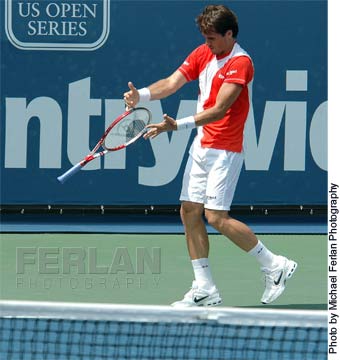

Haas and his opponent today, Marat Safin, have similar personalities. They’re both popular with the ladies – one discerning spectator hung a banner offering to marry Safin but only if he won – and they both blow up on the court. Safin berates himself and Haas berates himself and anyone else who happens to be in the vicinity.

The battle here was not a question of strategy as much as which player would self-destruct first.

Safin earned that distinction. He hit a silly unforced error in the first set tiebreaker and quickly found himself down 0-3. Then he hit a return into the net and there went the racket, not once, but twice into the carpet surface. That must have warmed Haas’ heart. Nothing is better that seeing your opponent blow up when, often as not, you’re the one that blows up first.

This is a quintessential example of Safin’s problem. It explains perfectly why he has only two grand slams despite having the most powerful game on tour. If you lose your temper, an entire set can go down the drain in a heartbeat. Safin lost the tiebreaker 7-1.

His difficulties continued in the second set. He slammed a ball to the backboard after hitting a ball long but Haas bailed him out. Serving at 3-4, Haas hit a few unforced errors and smashed a ball of his own then hit a double fault to give Safin the opportunity to serve for the set. Maybe it’s asking too much but shouldn’t Haas have learned something from watching Safin? Jeez, they deserve each other.

Safin won the game and the battle of the petulant children continued on to a third set. Haas regained his composure and remembered his first set strategy – hit a lot of backhand slices to dull Safin’s power. Case in point: with Safin serving at 1-2, Haas hit a backhand slice that stayed so low all Safin could do was slice it back. Haas then hit a forehand at such an angle that Safin ended up hitting a shot around the net post as his feet slid out from under him. The ball barely missed the sideline. A few more slices and Haas had the break and served out the set for a 7-6(1), 3-6, 6-3 victory.

James Blake will now have to sweat out the semifinals and, possibly, the final. This is almost as exciting as the NASCAR Chase for the Championship except that we don’t have players throwing debris onto the court hoping to injure their opponent – Robby Gordon was fined $15,000 for throwing rollbar padding onto the track at the Atlanta Motor Speedway last week.

Two more rounds to go.

Correction: James Blake lost to Tommy Haas. What can I say, it’s late in the season, I need a vacation.

See also:
2006 Paris Masters: The French Armada
2006 ATP Fantasy Tennis: Paris Masters

2006 Paris Masters: The French Armada

Tommy Robredo and Fernando Gonzalez needed good results here to get one of the three remaining spots in Shanghai and they had to go through a French player to keep their hopes alive.


I had heard of the Spanish Armada, a fleet of ships that picked a fight with England in 1588, and there’s even a tennis Spanish Armada which refers to the recent load of successful Spanish tennis players such as Juan Carlos Ferrero and Carlos Moya. But I didn’t know there was also a French Armada.

Two hundred and ten years ago, a French Armada consisting of forty-seven ships carrying 15,000 troops sailed to Ireland in order to end British rule and establish an independent Irish Republic. It didn’t succeed. Ten ships went down in a bad storm that made ship-to-ship communication difficult – they didn’t have cell phones back then – and the remaining ships limped home.

This week at the Paris Masters tournament, we have a new French Armada. Half of the twelve matches at the Paris Masters on Wednesday featured a French player. Two more matches featured players from France’s neighbor, Belgium. Tommy Robredo and Fernando Gonzalez needed good results here to get one of the three remaining spots in Shanghai and they had to go through a French player to keep their hopes alive.

The French crowd can be brutal and the French players can also be difficult. Sebastien Grosjean staged a nine minute delay of game in a match with Rafael Nadal at the 2005 French Open. Grosjean stopped play after the chair umpire refused to come onto the court and look at a ball mark. He walked around the baseline with an impish smile on his face as the crowd booed and yelled.

Grosjean behaved well on Wednesday but he must have felt like beheading the nearest person. He won the first set and was serving for the match at 5-2 in the second set when the trouble started. Grosjean couldn’t get his serve in – his first serve percentage dropped from 81% to 53% – and Robredo won the next five games to take the second set.

Grosjean could have been tired, it’s the last tournament of the year after all, but as hard as it can be for foreign players in Paris, it’s not so easy for French players either. They face tremendous pressure to perform well on French soil. Only two French players have won this tournament in its thirty-one year history – Grosjean won it in 2001, and only one French player has won at Roland Garros in the Open Era – Yannick Noah won the French Open in 1983. Grosjean must have felt the pressure as the games slipped away.

In the first game of the third set, Grosjean had break point when he pulled off the shot of the tournament. Robredo hit a drop shot and Grosjean came in and tapped the ball barely over the net. Robredo responded with a lob but Grosjean got back to the baseline, spun completely around and smacked a passing shot past a stunned Robredo.

It was short lived. Grosjean continued to lose his serve and Robredo took the match, 3-6, 7-5, 6-4. This was a huge win for Robredo because he’s barely holding onto the eighth position and only eight players go to Shanghai. Still, Robredo didn’t win the match as much as Grosjean lost it.

Gonzalez is sitting in ninth place in the standings and had to go through Julien Benneteau who didn’t behave so well. Everything went right for Gonzalez in the first set so Benneteau tried something different in the second set. He served and volleyed a little and came up with his own version of delay tactics. He repeatedly called time out or wiped himself off with his towel during Gonzalez’ serve.

With the score at 3-3 in the third set, Gonzalez had had enough. Benneteau came to the net and hit a sitter as hard as he could. Gonzalez sent it back twice as hard then yelled at Benneteau as if the say, “Take that, you @#$%%@@!!! Gonzalez now had triple break point and the enmity of the French crowd. But Benneteau thrilled the crowd by getting to game point and now Gonzalez was so annoyed he sent a ball to the top of the stands. Amazingly, a ball boy retrieved it and Benneteau won the game

With Gonzalez serving to stay in the set at 5-6, Benneteaul broke him and won the match, 3-6, 6-4, 7-5. Gonzalez must be bitterly disappointed. He’d dragged himself into ninth place in the 2006 Race rankings with three straight final appearances, one of them at the Madrid Masters. Since working with his part-time coach, Larry Stefanki, Fernando has developed some touch to go along with the sledgehammer ground strokes. Maybe he should have hired Stefanki a week or two earlier.

As always happens in Paris, the players who’ve already qualified for Shanghai stayed home because there’s no reason to risk injury. And even though I had a Nadal, a Ljubicic and a Roddick left to play on my ATP fantasy league team, I don’t mind because the matches are more thrilling without the big guys.

Look at this for instance: yet another French guy in the mix, Paul-Henri Mathieu, beat Novak Djokovic, 7-6(11), 7-6(4). Long live the French.

See also: 2006 ATP Fantasy Tennis: Paris Masters

2006 ATP Fantasy Tennis: Paris Masters

People left my house around 3am this morning after hanging onto the last gasp of our “Last Night at CBGB’s” Halloween party. CBGB’s was a legendary rock club in New York’s lower east side that recently closed. We had a few Joey Ramones and Andy Warhol turned up. Andy was a bit confused. He thought he was going to Club 54 but ended up at our party instead. Too many drugs poor guy.

My feet are killing me this morning and I can barely keep my eyes open. Worst of all, I woke up to my worst nightmare. I have a habit of forgetting to submit my team once I’ve written this column. Dumb, I know, but it means that I still had a Rafael Nadal, an Ivan Ljubicic, an Andy Roddick and a David Nalbandian to use in this very last week of the ATP fantasy tennis season. Alas, all four players are gone.

Ljubicic pulled out four days ago with a throat infection. Gimme a break, he’s already into the year-end tournament in Shanghai and doesn’t want to play. I don’t know what Nadal, Roddick and Nalbandian came up with as excuses.

Now you know. Never hold onto big players for the last tournament of the season.

Igor Andreev returns to the tour this week for the first time since April after having knee surgery. If I’d had knee surgery, I would not come back for the last tournament of the year against the best players in a Masters Series event. He hasn’t even played any challenger warmups. I hope he’s not coming back too early.

If Andy Murray can get by Paradorn Srichaphan, he can get to the quarterfinals. That’s not so easy, Srichaphan has two semifinals this fall and Murray hasn’t done anything. Still, Murray beat Srichaphan in Thailand last year in their only meeting so I’m picking Murray. Gael Monfils is lurking but that ankle looked so bad when he turned it at Madrid, I don’t see how he can play.

I also have Murray over Tomas Berdych but only because Berdych is defending a title here and he’s not shown me that he deals with such pressures very well.

How about adding trading capacity to the ATP fantasy league? Let’s say I decided to trade one Roddick for a Fernando Gonzalez earlier this season because I predicted that Larry Stefanki would push Gonzalez up the rankings. Of course I would have saved a few Roddicks for Wimbledon and the U.S. Open, but right now I’d be cleaning up because Gonzalez is playing well and Roddick is breaking down as he tends to do at the end of the year.

Which brings us to the biggest match of the tournament: Fernando Gonzalez versus Mario Ancic. Gonzalez is ninth in the race to Shanghai and Ancic is tenth. There are only eight spots available. Tommy Robredo is in the eighth spot and I have him going out to Sebastien Grosjean so this match is very important. Ancic won the title in St. Peterburg this week but Gonzalez has been to three straight finals. I’m going with Gonzalez.

If Gonzalez and Nikolay Davydenko meet in the quarterfinals there’ll be a few interesting subtexts. Davydenko injured his foot last week in St. Petersburg and retired. If Davydenko gets to the quarterfinals, he gets into Shanghai. It’s to his advantage to get to the quarterfinals then quit or, at least, underplay, because he still has to play in Shanghai and after Shanghai, he’ll play in the Davis Cup final. We know Davydenko isn’t that concerned about Davis Cup because he played in Beijing the week before the semifinals and was too tired to play, but I doubt he’d put himself through a semifinal in Paris if it impaired his chances in Shanghai.

Therefore, even though Davydenko is 3-0 lifetime over Gonzalez, I’m going with Gonzalez.

I ignored home court advantage for Richard Gasquet last week – he won the title in Lyon – but I’m not doing it this week. If Marat Safin gets by Robin Soderling he’ll meet Gasquet in the third round. Even though Marat Safin is 3-0 over Gasquet, I’m going with Gasquet because Paris is in France and two of Safin’s wins were in 2002.

Gasquet versus James Blake is hard to pick because four of the Shanghai spots are up for grabs and Blake is currently in seventh place. By the time this match is played, Blake might already have a spot in Shanghai and let up enough mentally to give the match to Gasquet. Gasquet is 1-0 over Blake and I think Blake will have hit spot in Shanghai if he gets to the quarterfinals so I have Gasquet all the way to the final.

Don’t be shocked if Federer loses this final if he meets Gasquet. Federer had a very tough time with Srichaphan last week, he barely pulled the match out in a third set tiebreaker.

Zero Counter

Each week we add up the number of matches between players who’ve never played each other before in an attempt to explain why there aren’t many rivalries on the tour – players don’t meet each other enough – and also show that there are too many tournaments with too few top ranked players to go around.

This week 20% of the matches are Zero Counter matches. That’s the same result we got for the Madrid Masters. The lower tiered tournaments have been averaging 33% Zero Counter matches.

There is one egregious example this week: Fabrice Santoro and Fernando Gonzalez have never played each other despite a combined total of twenty-four years on the tour. That is absurd.

Picks

Top tier picks (not that anyone has any left, mind you): Federer, Novak Djokovic, Davydenko, Gonzalez, Berdych, Murray, Blake, Gasquet. Second tier picks: Safin, Ancic, Robbie Ginepri, Srichaphan, Tommy Haas, Sebastien Grosjean.


Creeping fantasy sports disease

I was flipping channels the other night when I happened to see the show Arli$$. The main character, Arliss Michaels, is a sports agent. In this particular episode, Arliss was so intent on winning his National League-only fantasy baseball league that he maneuvered a trade to send one of his real-life clients to the American League.

I could sell the grass-court naming rights to Miracle-Gro or maybe High Times magazine. Just think of it, the ATP High Times Grass Court Top 100.

I can relate to that. I’ve been waking up in the morning thinking of new statistical methods I can use to propel myself to the top of the ATP Fantasy Tennis Season next year. One morning I woke up wondering if I could predict grand slam winners by looking at players’ records in Masters Series events. Then I went further. What about looking at their Masters Series records on different surfaces? And how about a surface adjusted ranking (SAR)? Take the top 100 players, upload all of their ATP points on the five different surfaces, then create a separate top 100 for clay court, outdoor hard court, grass court and indoor hard court.

I could sell the naming rights to four top 100 rankings instead of just one. I could sell the grass-court naming rights to Miracle-Gro or maybe High Times magazine. Just think of it, the ATP High Times Grass Court Top 100.

Yes, I’m turning into a fantasy sport fanatic. I’m beginning to understand why fantasy gamers hire biomathematicians at NASA.

Another morning I woke up thinking that I should be able to develop an algorithm to pick my tennis fantasy team. To test it out, I could run it on every tournament this past year and see how much prize money it wins. (ATP fantasy tennis gamers are ranked by the amount of prize money their players win.) Isn’t there a computer program of some sort that can look at the variables in my algorithm, assign weight to their importance, then adjust the weights until my algorithm generates the maximum prize money?

Yes there is.

In the October 16th issue of the New Yorker, Malcolm Gladwell wrote an article about a system that analyzes the scripts of big budget movies and predicts their gross income. The process involves using a computer program known as a neural network. The article also describes a neural network that predicts winners at the dog track using the same variables that greyhound experts use.

Now that I have CFSD (creeping fantasy sports disease), I want to do the same thing for my fantasy tennis team. My algorithm would mirror the process I already use to pick my fantasy team.

I start by picking winners in the draw of each tournament and that already presents a problem. There are thirty-one matches in a thirty-two player tournament and I have to pull up three web pages of statistics for each match. If there are three tournaments that week, that means I have to look at two hundred and seventy-three web pages. That’s totally ridiculous, it takes forever. What to do? I don’t need a biomathematician but I have contracted someone to write a screen scraper program. All I have to do is enter the names of the players and the program will go to the website and download all my data into one file.

Not only is my head now filled with arcane statistical possibilities, but everything I read goes through the CFSD filter. The ATP recently announced that thirteen tournaments will use the round robin format next season. That’s a problem for my algorithm. Each tournament has at least four qualifiers in the first round but when I pick the draw on Sunday morning, I don’t know who those qualifiers are because qualifying doesn’t finish till Sunday afternoon. Most of the time qualifiers lose in the first round and it’s not a big deal, but in a round-robin tournament every one plays at least twice so the qualifier will have a greater effect on the outcome. Also, if the tournament is a twenty-four player tournament, as some of the round robins are, qualifiers will be higher ranked players and that’ll make my predictions even less accurate.

I should be thinking about whether round-robin tournaments will increase the popularity of tennis. Tennis is losing traction in the U.S. ESPN dropped French Open coverage as of next year and though it’s been picked up by The Tennis Channel, it’ll reach far fewer households and viewers will have to pay extra to subscribe to the channel. Instead, I’m worrying about how round-robins will affect my algorithm and thinking of flying to Wisconsin at Christmas and freezing my patootie off just so I can hang out with my friend Billy and get help with this whole computer modeling thing.

I’m supposed to be a sports journalist and that means looking for a good story and showing the human side of sports. The subjects people really care about are the personalities, the drama and, let’s face it, the gossip.

Last week I wrote about a dustup between Mark Philippoussis and Nathan Healey at the Calabasas challenger. I got two email responses from the column. One woman wanted photos for her Philippoussis website and another was interested in pursuing the subject of sportsmanship in tennis. Nobody left me a message suggesting they were wowed by my statistical brilliance.

Two e-mails to zero. Maybe I should pay more attention to that statistic.

See also:
2006 ATP Fantasy Tennis: St. Petersburg, Lyon and Basel
2006 ATP Fantasy Tennis: Madrid Masters

2006 Calabasas and Madrid


The Madrid semifinals, and final for that matter, were not interesting. I was more affected by the news that Chris Evert is divorcing her husband Andy Mill after eighteen years of marriage. It pains me when things change unexpectedly. Not that I would have known if the couple had been having problems. Last summer, two couples I know broke up when one member of each couple decided to fall in love with each other. I was the last to know and that was discomforting also.

The semifinals continued one of Madrid’s themes – bad crowd behavior. The crowd booed throughout Tomas Berdych’s first service game and increased the volume when he made a mistake. It wasn’t unexpected considering Berdych kissed off the crowd at the end of his victory over Rafael Nadal. That also may not have been Berdych’s problem. He has a habit of getting a big win then losing easily in the next round. Fernando Gonzalez beat him, 6-3, 6-1.

In the other semifinal, Roger Federer beat David Nalbandian, 6-4, 6-0, then laid another bagel on Gonzalez in the final, 7-5, 6-1, 6-0. As you can see, that match went from o.k. to bad to just plain awful. Federer won the last eleven games. The only excitement happened after the match when Gonzalez accidentally aimed a sharp spray of champagne into Federer’s eye during the postmatch celebration and momentarily stunned him.

I saw more fireworks at the Calabasas Challenger, an event held about 30 minutes north of Los Angeles. Challengers are one level below regular ATP tour events.

Late in the second set semifinal between Mark Philippoussis and fellow Australian Nathan Healey, Healey complained to the umpire that Philippoussis was moving too much and distracting his serve. The umpire warned Philippoussis and he erupted. “Look, I’ve been doing this for twelve years. Please sit up there and do your job. Don’t tell me how to play tennis,” he said loudly, “I’ve never heard of this before.” Healey then walked towards Philippoussis and pretty soon the umpire had to jump down out of his chair and separate the two players.

Philippoussis was sitting in the tournament office after the match still complaining to an umpire when he said something that made the situation much clearer. Philippoussis said that Healey began to move laterally during his serve to distract him and he thought to himself, That’s a good idea, I think I’ll do that too. Then Healey complained about him to the umpire.

That’s pretty smart if you think about it. First distract your opponent during his serve then complain when he does the same thing to you. It has multiple levels of gamesmanship. It didn’t work, though, Philippoussis won the match, 6-2, 7-5, then took the Calabasas title with a 6-7(4), 7-6(4), 6-3 win over Amer Delic.

I spoke to Philippoussis after his semifinal. (Click on the video above to see Philippoussis play a point in the match. Video has replaced photo in the sports column world.) He’s been going to Las Vegas and working out with Andre Agassi’s team in Las Vegas, in particular, coach Darren Cahill and trainer Gil Reyes. We wondered what that crew might do after Andre retired and it’s not clear yet, but a tennis training center wouldn’t be unexpected.

Philippoussis’s goal is the same as everyone else’s in challengers: get into the top 100 and earn direct entry into ATP tour events instead of having to slog through qualifiers. The main thing he’s working on at the moment is getting back to playing as aggressively as possible after a slide down the rankings the past two years.

The ATP has slowed the game down since Philippoussis first joined the tour in 1994. Balls are bigger and the courts are slower. I asked him if he thought this was a good thing since he’s a serve and volleyer. He agreed that they’d slowed the game down to make the competition more even but, he said, “the good news is that they’re starting to quicken up again.”

He thought the American hard court season had quicker courts this year and he also said that the Australian Open court will be faster in 2007. I don’t know if the summer hard court season was faster, it seemed like wishful thinking to me, but if it helps him to think that, good enough.

I wouldn’t usually trade Calabasas for Madrid, but this weekend I preferred it.

See also:
2006 Madrid Quarterfinals: Is Berdych Better Than Nadal?
2006 Madrid Third Round: The Young And The Talented
2006 Madrid Second Round: Everything Is Upside Down
2006 Madrid First Round: Don’t Jump
2006 ATP Fantasy Tennis: Madrid Masters