Author Archives: nrota

2006 ATP Fantasy Tennis: Madrid Masters

I’m not crowing or anything, well, yes I am, I picked two upsets in Moscow. I had Jan Hernych over Filippo Volandri and Teimuraz Gabashvili over Gilles Muller. Okay, that second one was a minor upset but Volandri was the fifth seed. More incredible than that, I actually remembered to submit my team.

I picked four of the six finalist and it would have been five if Rafael Nadal hadn’t crashed out to Joachim Johansson in the second round. That was totally unpredictable. Johansson has a big game, in particular one of the best serves on tour, but this is only his second ATP regular tour event in more than a year after having shoulder surgery. He played in San Jose in February but dropped all the way to the futures circuit – the bottom of the minor leagues – in recent weeks.

By the way, here’s a bit of insight into how the ATP tour works: tennis-x.com and tennis.com cited an article in the Austrian newspaper Obersterreichischen Nachrichten that put Andy Roddick’s appearance fee in Vienna at $150,000.

Madrid Masters

The Madrid Masters plays on indoor hard court and pays $477,792 so get it right!

If you’re wondering why Johansson got into the main draw despite his ranking of 690, I am too. I believe it has to do with the concept of protected ranking, a player who loses time to injury gets special consideration. But that’s been addressed by using two different rankings: the Indesit ATP rankings stretch over the last 12 months to account for time off during that period and the Indesit ATP Race rankings count results during the calendar year only. Nikolay Davydenko should take Johansson out so it shouldn’t end up being an issue.

Tommy Haas has a career record of 42-16 on indoor hard court but Dominik Hrbaty beat him this week in Vienna with a bagel in the third set and also beat Haas last year in Madrid so I’m going with Hrbaty. Not only that but Hrbaty is 3-1 over Nadal winning all of their matches on hard court. Who knew?

I have two Nadals left so I have to use him in Madrid and Paris but the bigger question is whether to use my one remaining Roger Federer here or in Paris. Federer has been known to drop out of Masters Series events if they’re too close to each other. He essentially pulled a no show in Cincinnati after winning the week before in the Toronto Masters. Madrid and Paris don’t follow each other but the Masters Cup is one week after Paris and that’s enough for Federer to find a way to skip Paris. I will use Federer this week because I know he’ll show up.

In fact, you should use your big guys in Madrid because players come up with “opportune” injuries so they can skip Paris when they’re already in the year end Masters Cup.

Mikhail Youzhny is a bit of a wild card. He’s in the qualifying tournament because the seeds were drawn up before he made his semifinal run at the U.S. Open. He’s not that good on indoor hard court but check at the very last minute to see where he is in the draw and adjust your picks if necessary.

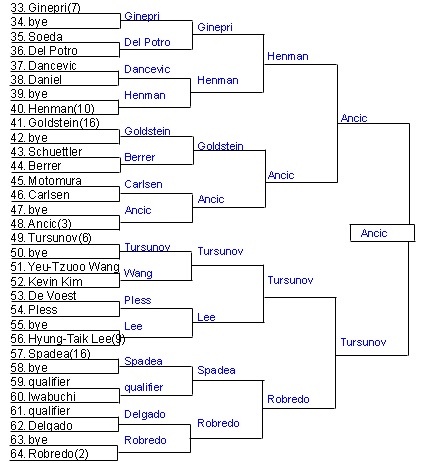
Mario Ancic has been in two finals and three quarterfinals in his last five tournaments. He’s highly motivated because he’s close to getting into the final eight at the Masters Cup in Shanghai and that should get him to the quarterfinals again this week.

Marcos Baghdatis is fighting for a final eight spot too but his second round opponent is likely to be Marat Safin. Baghdatis had an exceptional record on indoor hard court in challenger and futures tournaments but he’s only won one match there on the regular ATP tour so I’m going with Safin.

In my upset pick I have Novak Djokovic over Jarkko Nieminen. Nieminen got to the final in Stockholm this week but Djokovic is 11-3 on indoor hard court and 44-15 for the year.

I’m picking Davydenko over Fernando Gonzalez because Davydenko is 3-0 over Gonzalez lifetime. If Davydenko gets as far as the quarterfinals and meets Ivan Ljubicic, he should lose because Ljubicic has beaten him the last two times they’ve met including indoors at Metz.

Roddick is 5-3 over Ljubicic and it could have been 6-3 if he hadn’t been injured at Paris last year. Still, I’m going with Ljubicic because he won this week and got to the finals last week.

Zero Counter

Each week we add up the number of matches between players who’ve never played each other before to explain why the ATP doesn’t have any rivalries – you don’t get rivalries if players never meet after all. You’d expect the number to be lower this week because this is a required tournament and these are the top ranked players on the tour and you’d be right. Up until now, one third of the matches have been Zero Counter matches but this week it’s one fifth of the matches.

Still, look at some of the players who’ve never met before: Andy Roddick and Tomas Berdych who’ve been on the tour for a combined total of nine years; Dmitry Tursunov and James Blake who’ve been on the tour for a total of thirteen years; David Nalbandian and James Blake, also a total of thirteen years on the tour. See what I mean, these guys never meet.

Picks

First tier picks: Federer, Ancic, Nalbandian, Blake, Davydenko, Ljubicic, Roddick, Hrbaty. Second tier picks: Robin Soderling, Tommy Robredo, Tim Henman, Safin, Gonzalez, Djokovic and Berdych.

Correction
Thanks to vive le beau jeu! on the Talk Tennis forum, the issue of protected ranking and Joachim Johansson has been cleared up. The protected ranking rule is described here. If a player doesn’t compete due to injury for more than six months, he can petition to keep a ranking equal to his average ATP ranking during the first three months of his injury and he can use this ranking for his first eight tournaments back on the tour.


2006 Stuttgart: Eastern-European women, injuries and two-handers

U.S. tennis is turning out players, they just don’t happen to be American.


When a person puts an X in the box next to the word Caucasian, they are aligning themselves with Europe and Asia. The word Caucasian comes from the Caucasus Mountains which, with the Ural Mountains, form the border between Europe and Asia. I was always confused about this because the Caucasus Mountains wander through Russia so does that mean Russia is part of Europe or Asia? The answer is that the western part of Russia, Moscow included, considers itself European and the rest of Russia considers itself Asian.

What about Maria Sharapova, is she an Eastern-European? She was born in Russia but she’s lived in the U.S. since she was seven years old. Then there’s Tatiana Golovin. She was born in Moscow, moved to France and now lives in Miami. When we say that tennis in the U.S. is slipping because there are no women in the top ten and the men aren’t filling up many grand slam final slots, that’s not totally accurate. U.S. tennis is turning out players, they just don’t happen to be American. These players train in the U.S. – often from an early age – it’s just that they don’t carry a U.S. passport.

And even if they didn’t come to the U.S. at an early age, they might play tennis at a U.S. university. More than fifty percent of the top male NCAA tennis players are foreigners. Benjamin Becker, a German who beat Andre Agassi in the last match of Agassi’s career and got all the way to the Tokyo semis this week, spent four years at Baylor University.

Three of the four semifinalists in Stuttgart this week are Eastern-European if you count Golovin. Svetlana Kuznetsova and Nadia Petrova are the other two. Why are there so many Eastern-Europeans on the tour and why do Russian women make up half of the top ten?

If you want to make money as a female athlete, you can play tennis, golf, basketball, volleyball or go into track and field. You could also be a bowler. This year Kelly Kulick became the first woman to qualify for the Professional Bowling Association tour. And Michelle Wie is doing her damndest to qualify for the PGA tour. But there aren’t so many golf courses in Eastern Europe. There are beaches in Russia but Russia is the largest country in the world. Going to the beach there is not like hopping a plane to Florida from Chicago to play a little volleyball.

You could play basketball if you’re tall enough, many of the Eastern-European women on the WTA tour are certainly tall enough, but there’s not a lot of money in it. The average WNBA salary is around $50,000. Serena Williams wouldn’t go halfway to Dubai for less than four times that in appearance money alone.

Not many hundred meter races give out a fire engine red Porsche along with first prize money as they do at the Porsche Tennis Grand Prix – the name of the tournament here in Stuttgart. While we’re at it, see if you can give me the name of a famous Russian female track athlete. I can’t think of one either but I did think of a famous Russian tennis player: Anna Kournikova.

I’m not suggesting that Eastern-European women are only in it for the money, I’m suggesting that they’re smart enough to choose the most lucrative sport with the best press coverage that lets you travel all over the world.

The fourth semifinalist in Stuttgart is Patty Schnyder. She’s currently ranked number nine and needs to get to number eight to qualify for the year end championship in Madrid. That shouldn’t be too difficult. Tennis-X reports that half of the top fifteen WTA players are out with injuries – wait a minute, how do you divide fifteen in half? Anyway, Amelie Mauresmo pulled out of Stuttgart with a shoulder injury and Golovin got a walkover when Elena Dementieva strained a quad muscle. Kim Clijsters, Justine Henin-Hardenne, Maria Sharapova, Lindsay Davenport, and Serena and Venus Williams are all out for one reason or another. At this point, Schnyder could end up ranked number fifteen and still get to Madrid because so many people in front of her could drop out due to injury. Hell, I might as well get a ticket to Madrid and see if they can use me.

Why are there so many injuries? Let’s go over it again:

  1. The new racket technology is hard on a tennis player’s body because there is greater shock to their system when they hit the ball.
  2. Women players usually start on the tour when they’re teenagers and sometimes start in their early teens. By the time they reach their twenties, they can wear out physically.
  3. The off-season is too short.
  4. There are too many tournaments in too many parts of the world.

This last issue is a place where I disagree with Tennis Magazine’s Peter Bodo. He thinks the number of tournaments the WTA requires you to play doesn’t add up to a big workload, it’s the players who wear themselves out by running all over the world chasing money and ranking points. But the tennis season is set up to make it a long haul. The first part of the year is preparation for the Australian Open with the spring and summer for the other three slams. That leaves the fall for grabbing enough ranking points to get one of the eight positions in the year end tournament. Who in their right mind doesn’t want to be one of those eight players?

As for the off-season, it’s even shorter for the Russian and Argentinean men this year. The Davis Cup final between those two countries starts on December 1st so they have less than a month off. That’s ridiculous.

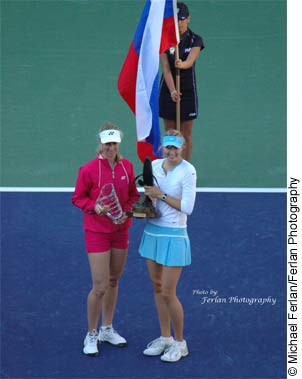
Both semifinals in Stuttgart followed the same line of action. Golovin, playing against Schnyder, and Petrova, playing Kuznetsova, both won the first set easily, lost the second set, then held on to win the third set and the match. Petrova beat Golovin in straight sets to take the title and that beautiful red Porsche.

Eastern Europeans won two of the three tournaments last week. Alona Bondarenko from the Ukraine won the title in Luxembourg and Anna Chakvetadze from Russia won the tournament in Guangzhou. Don’t look for this trend to change any time soon. A wild card named Iroda Tulyaganova from Uzbekistan made it all the way to the finals in Tashkent – where on earth is that? – this week before losing to Sun Tiantian of China. If Uzbekistan can turn out tournament finalists, can’t the U.S. states of Alabama or Tennessee do the same thing?

Name me one player with a one-handed backhand who’s had wrist surgery.

Here is a trend I would like to change immediately. The women’s final in Tokyo this week was the first final in WTA history featuring two players who hit two-handed off both sides. Marion Bartoli hit enough awkward two-handed shots to beat Aiko Nakamura and take the title.

I cringe when I see players hit two-handed volleys. A two-handed forehand escalates that cringe into a full-on upset stomach. It’s not a new thing, Monica Seles won nine grand slams with two hands on both sides, but I’m afraid it’s a monster that will multiply.

With the powerful rackets players use today, the focus has turned away from the development of an all-court game with the occasional use of touch into a monster slamfest where each player stands on the baseline and hits the ball as hard as she can. Technique is reduced to using whatever stroke gets the most power no matter how ugly it looks.

Besides looking ugly, it’s an error to think that you can hit the ball harder with two hands than one. The one-handed backhand will generate more power because it has a greater range of motion than a two-handed backhand. You can swing the racket much further. And anyway, tennis instructors teach you to hit the two-handed backhand, if you’re right handed, by swinging the racket with your left hand only. The right hand should be used for balance, not power. So you’re essentially hitting the ball with your weak hand through a shorter range of motion. That gives you the worst of both worlds.

Don’t get me wrong, I hit a two-handed backhand. I have no choice, whenever I hit a one-handed backhand I get tennis elbow. But I wouldn’t do if I had any other choice and most of us can at least choose a one-handed forehand.

One last comment about all of this and I’ll shut up. Name me one player with a one-handed backhand who’s had wrist surgery. Then tell me the names of players with two-handed backhanders who’ve had wrist surgery. I can think of two right away: Jimmy Connors and Kim Clijsters.

If you can think of others, either one-handed or two-handed, who’ve had surgery, you know what to do: leave a comment.

See also: State Of The Women: The Serve, The Nerve, The Size

2006 ATP Fantasy Tennis: Moscow, Vienna, Stockholm

See, I told you not to go with David Ferrer and Juan Carlos Ferrero last week even though they were the number one and two seeds in Metz, they both lost in the first round.

The Madrid Masters Series event will be held next week in, of all places, Madrid and will pay the winner over $477,000, but this week is almost as lucrative. If you manage to pick the winner in all three tournaments – Moscow (indoor carpet, pays $142,000 to the winner), Vienna (indoor hard court, $137,270), and Stockholm (indoor hard court, $121, 3440) – you’ll win a total of $400, 614.

That’s a good thing for me because I need the money. Last week I figured out the draws, sent out my subleague email, posted on the Tennis Talk forum, then, for the third time this year, forgot to submit my fantasy team! I give up, I’m just hopeless.

Our guy Benjamin Becker is racking up more footnotes. His first footnote was being the player who beat Andre Agassi in the last match of Agassi’s career. Becker picked up his second footnote last week in Tokyo. He beat Jiri Novak in a match that ended at 3:24 am, the latest finish of a match in ATP history. Just as I was getting concerned that his career might consist entirely of footnotes, he managed to get all the way to the semifinals before falling to Roger Federer. Good work Benni.

Moscow

It’s shouldn’t be a surprise that I have an all-Russian semifinals in Moscow, there are seven Russian players in this tournament.

Be careful about Nikolay Davydenko. He won this tournament two years ago but he could meet Max Mirnyi in the quarterfinals and Mirnyi has beaten Davydenko in Moscow. Also, Davydenko lost to Daniele Bracciali in the first round here last year.

Davydenko is 2-0 lifetime over Mikhail Youzhny and even though that was a few years ago, I’m still going with Davydenko because Youzhny lost in the first round on carpet last week. If that sounds like contradictory information about Davydenko, well, life is full of contradictions isn’t it. Besides, does anyone have any Davydenko choices left after the clay court season?

I have Igor Kunitsyn in the quarterfinals only because he made it to the semifinals here last year.

Dmitry Tursunov also got to the semis last year and he’s been doing well but he always makes me nervous. He insists on hitting the ball as hard as he can regardless of the score so his results are inconsistent. Sometimes I think it’s his revenge on an overbearing father who pushed him into tennis. When I was growing up I was extremely mad at my mother because she was so critical, but she’d hit you up the side of the head if you talked back to her so I proceeded to act out indirectly. I’d break things I was supposed to be cleaning and, worst of all, I’d take it out on myself by moping around instead of pursuing things I really wanted to do. That’s what Tursunov does: he plays mindlessly even though he’s a very intelligent guy as if to prove to the world that he really shouldn’t be playing tennis. He should be a writer for Saturday Night Live or performing with an improv group in a small theater in Hollywood, neither of which would thrill his father.

If Paul-Henri Mathieu gets to the quarterfinals and faces Marat Safin it could be interesting because Mathieu has beaten Safin here in Moscow and he beat him this year at Monte Carlo, though that was on clay. Safin should win it though.

Safin has played two indoor tournaments this fall while Tursunov has been fooling around on clay and outdoor hard courts so I’m picking Safin. And Safin has beaten Davydenko twice on hard courts this year so he’s my pick in the final too.

Vienna

Ivan Ljubicic is the defending champion and he’s 13-2 indoors this year but remember that there are two Masters Series events left and they’re both indoors. Besides, Marcos Baghdatis is 2-0 over them and they could meet in the semifinals. I have Baghdatis in the finals but he’s had a strained shoulder so I’d save him for the Masters Series events too.

Whoa, Sebastien Grosjean is 8-0 over Xavier Malisse. I don’t remember seeing such a lopsided record outside of Roger Federer’s 11-1 record over Andy Roddick. On the other hand, Roddick is 7-1 over Grosjean should they meet in the quarterfinals.

Can you believe that Roddick and Richard Gasquet have never played before? If not, see Zero Counter below. They should meet in the second round. Roddick has an excellent indoor hard court record so I’m going with him.

David Nalbandian is an unknown. He’s had an abdominal injury and a case of wavering attention. I’d save him for the Masters Series events and use this week to see if his head is back in the game of tennis.

Stockholm

Mardy Fish versus Paradorn Srichaphan is a tough call. Srichaphan got to the semis last week but Fish got to the third round and Fish is 2-0 over Srichaphan. Fish has a better record this year so I’m going with him.

I give up on Robin Soderling, I keep picking him and he keeps losing.

James Blake should get to the final and beat Rafael Nadal but, and this is the mantra this week, save top players for Madrid and Paris. Choose second tier players and hope they can bring home some of the big money out there this week.

Zero Counter

Safin has been on the tour for nine years and Fernando Verdasco for five and they’ve never played each other. Carlos Moya and Nicolas Almagro are both Spanish clay court specialists and they’ve never met. Moya has been on the tour for eleven years, Almagro for three.

Each week I add up the number of matches between players who’ve never met each other. I call it the Zero Counter. I’m keeping track so I can see if this improves when the ATP introduces round-robin tournaments next year. The ATP needs new faces but it needs rivalries more and you don’t get rivalries if players never meet.

Zero Counter for this week: 30 matches. That means that one third of the matches this week are Zero Counter matches, same as last week. Notice that this number would be even larger if I knew the names of the qualifiers because you can be sure that some of the qualifiers have never played their opponents before.

Picks

First tier picks: Davydenko, Safin, Nadal, Blake, Baghdatis, Roddick, Tursunov, Tomas Berdych. Second tier picks: Youzhny, Mathieu, Kunitsyn, Gonzales, Grosjean, Novak Djokovic, Jarkko Nieminen, Rochus.


2006 ATP Fantasy Tennis: Tokyo and Metz

Tokyo ($118,000 to the winner – nothing to sneeze at, outdoor hard court)

Wow, our guy Benjamin Becker is seeded this week in Tokyo and gets a bye to the second round. This is the first time he’s been seeded in a regular tour event. Good work Benni.

Ivan Ljubicic lost in Bangkok to James Blake but he made it to the final in the first indoor hard court event of the year. I’ve been telling you, save him for the indoor season, particularly the indoor Masters Series events in Madrid and Paris.

I criticized Blake last week by saying that Marco Baghdatis had more heart and was more likely to make it to the final eight and qualify for the year-end Masters Cup but so far I’m wrong, Blake catapulted from number nine to number six with his win this week.

Dmitry Tursunov has turned into a clay court monster. He won the clinching match in Davis Cup against the U.S. on soft indoor clay then he took out Tommy Robredo last week in Mumbai. It’s strange enough that Tursunov chose to play in a late season clay court tournament instead of an indoor hard court event but then he gets to the final, what’s the world coming to?

By the way, check out his hilarious blog. I’m not sure he wouldn’t have been a star in the entertainment world if his father hadn’t hounded him into moving to the U.S. from Russia when he was twelve years old to pursue tennis. In between his hilarious stream of consciousness musings at ATP media sessions, you can hear some of the pain he experienced in his youth. When a journalist asked him for the players who inspired him when he was young, he answered that he didn’t have any idols, once he got off the tennis court he didn’t want to think about tennis any more. This is not the response of someone who was passionate about tennis.

Robredo and Tursunov should meet in the fourth round here and it’s hard to choose because Robredo got to the semis in Cincinnati and the fourth round at the U.S. Open. I’m going with Tursunov out of convenience because I used all five of my Robredo choices during the hard court season.

Metz ($55,742 to the winner, indoor hard court)

This looks more like a clay court tournament than a fast indoor tournament, David Ferrer, Albert Montanes, Ramon Ramirez-Hidalgo, Olivier Patience are entered, but there’s nowhere else to go because all of the good hard court players are going for twice the money in Tokyo.

Ferrer is the top seed but his first round opponent, Marc Giquel, beat him indoors in their only meeting – he bageled him in the second set – and has a better career record indoors. Robin Soderling is also 3-0 against Ferrer so I’d stay away from him.

The Russians Marat Safin and Mikhail Youzhny meet in the first round because Safin is still in the rankings pit at number 72 but Safin is better indoors. However, it’s a close call so be careful about picking Safin.

Juan Carlos Ferrero is seeded number two but his first round opponent, Julien Benneteau, has a comparable hard court record this year and Ferrero lost in the first round to a qualifier last week on a hard court.

I picked Soderling to do well in the U.S. Open and he tanked but he looks good to me this week. The bottom half of the draw is mushy, Novak Djokovic, Richard Gasquet and even Xavier Malisse could get to the final.

Picks

Go with five players at the richer tournament in Tokyo and three at Metz. Top picks: Ancic, Tursunov, Robredo, Andy Murray, Jarkko Nieminen, Soderling, Djokovic, and Gasquet. Second tier picks: Paradorn Srichaphan, Ginepri, Safin, Grosjean.

I’m always complaining about the number of ATP matches between players who’ve never met before even though they may have been on the tour for years. It’s one of the reasons there are almost no rivalries on the ATP tour, a big problem because rivalries are the heart of a sport’s appeal. This happens for two reasons (if you can think of more, leave a comment). 1. There are usually two or three tournaments in the same week in different parts of the world. 2. At least four spots in each tournament are filled with qualifiers and at least two spots are filled with wild cards. I can’t think of another sport at the moment which does this.

This situation will improve when the ATP introduces round-robin events next year but for the meantime I’m going to keep track of the percentage of matches in each tournament between players who’ve never played each other in a regular tour event before. Let’s call it the Zero Counter because the head-to-head record between these players is 0-0.

I forgot to do it for Tokyo but at Metz, 11 of the 31 matches are Zero Counter matches for a percentage of 31%. In one third of the matches, the players have never met before. I think that’s pitiful.


Costa Mesa futures: a trip around the world


I love my job. Two weeks ago I went to a futures tournament in Claremont, California, and spoke to a player whose grandfather was a cricket legend in India. Last week I went to a futures tournament further south in Costa Mesa and traveled from the Israeli/Lebanon border to Ghana then on to Basel and the Philippines before ending up in New Mexico. Along the way I learned a lot more about Roger Federer, Andre Agassi, Marcos Baghdatis and U.S. college tennis that I ever expected.

Dudi Sela was the top ranked player in the Costa Mesa tournament. Earlier this year he was ranked number 160 but then he broke his elbow during a training accident and dropped into the 300’s. He took the title at Claremont and is ready to climb back up the rankings.

Sela’s hometown, which he stills calls home, is Kiryat Shmona, a small town in Northern Israel two miles from the border with Lebanon. As you can imagine, it’s been the target of Hezbollah rocket attacks on many occasions. Five or six years ago Sela was hiding out with his family in their basement shelter when a rocket blew out the windows and doors of the house. Sela hasn’t lost any family members but he knew people in town who died in rocket attacks.

At one point Sela lived in Paris for a year and practiced with his best friend Marcos Baghdatis. I once asked Baghdatis why he plays so well against top ten players but I didn’t get a very good answer and now I could ask his best friend. Sela’s answer: “Because he’s bored, he wants to play the big guys.” I also asked Sela why Baghdatis is so good. Sela tapped his chest and said, “Big heart, he has a big heart and he’s talented.”

Henry Adjei-Darko is from Ghana. He’s a tall player with an aggressive game and graceful, powerful strokes. When he hits a forehand he jumps into the air and his shirt goes flying as the racket wraps around his body. And this is despite injuring his foot a few days earlier. While he gets treatment for his foot after winning his match, I check into a match with a player from the Philippines, Patrick-John Tierro. I know there aren’t many players from Ghana but what about the Philippines? Their top two players, Cecil Mamiit and Eric Taino, were both born in the U.S. and live in Los Angeles but play for the Filipino Davis Cup team.

That’s just the beginning of the U.S.-Filipino connection which has a long history. Before we get into that, though, let’s take a short twenty year trip to Switzerland. Tierro’s coach is Beeyong Sisson, a former ATP player who is a delightful and talkative fellow. I started out by asking my usual question – what kind of support does your country’s tennis association give young players? – and got the usual answer: not much. But then, to my utter surprise, Sisson mentioned that he coached in Basel, Switzerland for twenty years and I immediately switched the conversation to Roger Federer.

“Wow,” I said, “that means you watched Roger Federer develop.” Yes he did and he even coached him at times because he was a Swiss National Coach assistant. The next obvious question was, “Okay then, why is Federer so good?” The first two reasons Sisson gave were expected. Federer’s game is well-rounded because he’s well-rounded as a person and also because he was a ball-boy for many years at the Basel indoor tournament so he got to see the best players such as Becker, Sampras and Agassi. But Sisson’s next statement was something different:

Agassi, in my opinion, if he had not gone to this academy early on, I think he would have gotten more grand slams than Pete.

Sisson is referring to the Nick Bollettieri Tennis Academy, Andre Agassi was sent there by his father when he was fourteen years old. Sisson was making the point that players in Switzerland had an emotional connection to their community and they were allowed to develop into full human beings before they started their life on the tour. Life at tennis academies can pressure players to get immediate results and that can end up stunting their game and their emotional development.

Agassi described his life at the academy in an interview with Gary Smith for Sports Illustrated on the eve of his retirement. Agassi was a terrified and lonely teenager while he was living away from home. He turned pro partially to escape the academy atmosphere but it didn’t help. He got to number one in the world but he still wasn’t sure who he was. It took a painful tumble to a ranking of 141 and therapy to finally come to terms with his father, the same man who answered his son’s phone call telling him he’d won Wimbledon by saying, “You should have won in four.”

We don’t know what would have happened if Agassi had stayed at home, he might have gone through the same emotional turmoil, but he would have been able to work through his difficulties with his family. We also don’t know if Agassi would have won slams without going to a tennis academy, but Federer is a good example of a player who was given time to develop in a more integrated environment. As is Pete Sampras who grew up and learned to play in Southern California.

After those twenty years in Switzerland, Sisson returned to the Philippines and established a tennis center in Subic Bay which was the closing of an interesting circle. The father of Patrick-John Tierro – the young Filipino who Sisson is coaching here – was born in the U.S. and served a career in the U.S. Navy. After he retired he moved to the Philippines and lives in Olongapo City which surrounds Subic Bay. The U.S. had owned and run Subic Bay as a naval base since the end of the Spanish-American war. In 1946 the Philippines finally became an independent country and signed agreements with the U.S. to continue to maintain military bases on their soil. Three months before the last agreement was set to expire in 1991, Mount Pinatubo erupted and destroyed Clark Air Base, a U.S. Air Force base, and dumped a foot of volcanic ash onto Subic Bay.

Many Filipinos were unhappy about the U.S. presence in the Philippines and the Mt. Pinatubo eruption was a symbolic last blow. After the agreement expired, the U.S. was given three years to leave and Subic Bay is now a commercial and industrial site with resorts, shopping, and a thriving tennis center.

After talking to Sisson, I finally managed to track down Henry Adjei-Darko just as he was leaving the site. He was limping with an ice bag on his foot but was nice enough to stand and talk to me. As I suspected, Adjei-Darko did not receive much help from the Ghanaian tennis association but he did get help from the International Tennis Federation (ITF), the world governing body of tennis. The ITF gives financial help to the top ranked juniors in many different countries so they can travel to junior tournaments and improve their game. For help in the pro ranks, though, Adjei-Darko gets help from a private sponsor who lives in Orlando. It’s not uncommon, Tierro also has a sponsor who is a businessman in the Philippines.

I wanted to end this trip around the world by speaking to an American player so I tried to track down Stanford player Matt Bruch, the number 10 player in the NCAA rankings, but I couldn’t find him so I asked the man standing next to me if he knew where Matt was. Pay dirt. It turns out I was speaking to Alan Dils, the tennis coach at the University of New Mexico. I’ve been asking players about foreign students taking scholarships at U.S. universities, now I could ask a coach.

Let’s start with the current NCAA rules: 1. a player must start college by the time he or she is twenty years old. The original rule required that a player must start at a U.S. college by the time they were twenty but that’s been relaxed to include any college. 2. A player cannot play in an organized tennis event between the time they are twenty and the time they start college.

How does Dils how feel about foreign students on U.S. college teams?

Personally I think it’s great that the number seventy-five team can beat the number twenty team in the nation right now.

Not only do foreign players bring depth to the college game but without the foreign players, top teams would get the best players and, as Dils said, “the rich would get richer.” Stanford is one of those rich teams and they’re one of the last teams to give a scholarship to a foreign player. They had no choice because they no longer have their pick of the top players since there are so many good tennis programs now.

But Dils isn’t totally happy. There are a lot of loopholes to the rules. Players can enter professional events before turning twenty and they can also purchase transcripts, particularly in Eastern European countries where the bureaucracy can be hard to infiltrate. With a purchased transcript, a player can play professionally while they are supposedly going to college full time then enter a U.S. college at age twenty-two with three or four years of professional tennis experience. Dils said “I know for a fact” that this has happened.

Dils would be happier if the age limit was reduced to nineteen and the twenty and under college requirement was limited to U.S. colleges. He would also like the rules enforced as they are. Andre Begemann, a player from Germany, won the deciding match that gave Pepperdine the NCAA title this spring. Begemann broke the rules by playing a professional tournament after his twentieth birthday and before starting college but the NCAA gave him a waiver because the match was within a month of his birthday and he played only one match. Begemann will be a twenty-two year old sophomore at Pepperdine this year.

I’ve written about foreign tennis players at U.S. colleges a number of times and I’ve always championed an open door policy because U.S. tennis will only get better against the best players. But now, in agreement with Dils, I’d reinstate the original rule requiring players to enter a U.S. college by age twenty else we’ll soon have twenty-five year olds winning the NCAA title.

That ends our world tour for today. There’s another futures tournament this week in Irvine. I’m getting a bit tired of traveling so I plan to speak to U.S. players this time around.

See also:
U.S. College Tennis And The Mother Of Exiles
Benjamin Becker’s Journey To The ATP
Becker And The NCAA