Category Archives: Uncategorized

Dick Pound and WADA reach altitude

Pound himself is more than a watchdog, sometimes he sounds like a bulldog frothing at the mouth.

Believe it or not there is no ATP tournament this week. Yeah, finally, a week off. I have no idea why they don’t take a week off after the U.S. Open, I have no idea why they don’t take a week off after every grand slam. I suppose early round losers in the slams need something to do.

It’s vacation week for me, I don’t have to slog through pages and pages of statistics and fill out tournament draws. Speaking of which, I’m starting to work with a screen scraper program, software that is programmed to go to a websites and collect (scrape) information from the page so you don’t have to do it manually.

For instance, if I want to predict the outcome of a match between Nikolay Davydenko and Marcos Baghdatis, I would start by looking up their head-to-head record on the ATP website. If Davydenko had a 6-0 record over Baghdatis then I’d be done because I’d pick Davydenko to win. But Davydenko has a 1-0 record against Baghdatis, not conclusive at all, so next I would go tennis.matchstat.com and look up each player’s record for the last year then use that information to compare the players and pick my winner.

So far I’ve gone to three different web pages and that’s just to predict one match. If I’m picking a tournament with a thirty-two player draw, that would be a total of thirty-one matches times three web pages for a total of ninety-three web pages. If I program a screen scraper to get the data, all I have to do is enter a list of paired opponents for each round of the tournament and the screen scraper program would collect the data for me. It’s a fantasy player’s delight! When I get it working, I’ll tell you how to do it.

Meanwhile let’s look at some drugs. Drugs are an issue in most sports and that includes tennis. Guillermo Canas just won a challenger event in Brazil after returning from a fifteen month ban for using a diuretic that can used as a masking agent. In cycling, Floyd Landis will likely lose his Tour de France title after testing positive for synthetic testosterone and Lance Armstrong is feeling the heat as two of his teammates admit to using performance enhancing drugs.

That subject has been well covered but what about illegal training techniques, is there any such thing? I’m not aware of any though I suspect taping a football player to a movable object and letting other players use him as a tackling dummy might be illegal or, at the very least, worthy of a lawsuit. As brutal as that sounds, I do remember a case where a college football coach held a player while other players tackled him. Besides getting the strong message that he wasn’t very important to the team, the poor guy ended up with a bad shoulder injury.

When the World AntiDoping Agency (WADA) met last Saturday, they considered creating an illegal training technique by outlawing an object used to mimic high altitude training known as an altitude tent. WADA is the agency that controls drug testing in Olympic and some non-Olympic sports. The tent is under scrutiny by an anti-doping agency because athletes can use the tent to stimulate the production of EPO. This increases the number of oxygen-carrying red blood cells and improves speed, strength, endurance and recovery. Athletes gets the benefit of high altitude training without moving to Boulder, Colorado.

A synthetic version of EPO is the substance all those cyclists were caught with in this year’s Tour de France and it’s the same substance that Marion Jones almost got caught with, her A sample tested positive but her B sample was negative. That result warrants a revisit to one of the many attacks on Lance Armstrong.

Don’t get me wrong, it’s hard to believe that someone can win seven straight Tours when it seems like every other rider was using EPO, but when a French lab tests urine samples from the 1999 Tour de France in a research project and positive tests from those samples get connected to Lance Armstrong and those leaked results end up in the French newspaper L’Equipe, which just happens to be owned by the same group that runs the Tour de France, this does not qualify as valid anti-doping procedure.

The samples in that French laboratory were all B samples, the A samples no longer exist. WADA requires an A and B sample to test positive and the Marion Jones case shows the importance of that. After the L’Equipe article was written, Dick Pound, head of the WADA, called the tests “as close to 100 percent reliable as you could get” even though they were B samples.

Under Pound, WADA has turned into a very aggressive watchdog. The list of banned substances has multiplied and WADA is currently lobbying governments to ratify UNESCO’s Convention Against Doping In Sports which would make WADA’s regulations enforceable by law. If this is successful, WADA will have gone from policing Olympic sports to establishing global anti-doping laws dictated by its policies.

Pound himself is more than a watchdog, sometimes he sounds like a bulldog frothing at the mouth. He recently wrote an op-ed piece in the Ottawa Citizen – Pound is a Canadian and WADA is based in Montreal – in which he asked cyclist Floyd Landis and sprinter Justin Gatlin, who also tested positive for testosterone, to reveal their enablers, the people who provided them with drugs. He also took on the USADA and cycling with a rudeness that has pissed off many athletes and athletic organizations:

Who knows, USADA (the United States Anti-Doping Agency) may subscribe to a suggestion that both athletes (Gatlin and Landis), in separate sports, were ambushed by a roving squad of Nazi frogmen and injected against their will with the prohibited substances.

Take cycling in 2006. If 2006 were to be measured in the Chinese cycle, it would be the Year of the Excrement.

Pound is breaking the rules here, an athlete has to be proven guilty not indicted by WADA’s loudmouth president in the media. Still, his persistent criticism of cycling seems more accurate every day. And as much as I’d like to blame him, as Lance Armstrong does, for pressuring the French lab to produce the reports that linked Armstrong to the 1999 positive test samples, there is conflicting evidence. However, when it comes to outlawing altitude tents, Mr. Pound’s ego has outdone itself.

How would he enforce the ban? How will WADA distinguish between athletes who live at altitude and those who sleep in altitude tents? Why not just ban athletes who live at altitude because they have an unfair advantage? While they’re at it, WADA should ban Eli and Peyton Manning because they have unfair genetic advantage and ban LeBron James because he’s so damn talented. That’s unfair isn’t it?

I’d like to think that the world doesn’t need international anti-doping laws, I’d prefer that the individual sports organizations handled the matter, but it’s like unsolicited phone calls. Marketing companies put themselves out of business by failing to police themselves thereby spawning the National Do Not Call Registry and cycling seems to be doing the same thing. No one trusts cycling to clean itself up and this will move countries to accept global anti-doping laws administered by WADA and the huge ego of Mr. Pound.

WADA thankfully declined to outlaw the altitude tent last Saturday but it assures us that the tent is still under scrutiny. Drug testing in cycling and track and field is a mess but the thought of the egotistical and offensive Mr. Pound becoming the global anti-doping czar scares me. I’d like public pressure and investigative journalism to force cycling and track and field to clean up their act rather give the job to a man who wants to take over the world.

See also: No More Heroes – Palmeiro and Armstrong
A Demi-God’s Demise?

Imagine yourself in a doctor’s examination room with one of your teammates and his doctors; you and your wife (who is with you) think you should leave, just for privacy’s sake. But your teammate asks you to stick around anyway. After all, you’ve been teammates and buddies for a while so no secrets here. Then the doctor asks your teammate what drugs he has ingested over the years. He ticks off a list that includes some substances you know are illegal. You are more than a little surprised, but you know you heard what you heard. Your wife heard it too.

That was the situation cyclist Frankie Andreu was in some ten years ago. His teammate was Lance Armstrong. At that time he had just started his recovery from testicular cancer. This episode was publicly reported back in July of this year. Armstrong has denied that he ever said such things. His doctors support his version of events. But Andreu and his wife Betsy have maintained they heard what they heard.

The Andreus were obligated to give testimony in court, which is how this story came out initially. The case involved a promotional company who had withheld Armstrong’s bonus money because of doping allegations. Armstrong won his case and got his money, with interest.

But now there is a further story on all this in Sports Illustrated this week. Not a pretty story. In fact it will probably rock the world of professional sports and far beyond it.

We all know how endurance athletes love their spaghetti and other pasta dishes. But will this be the week when the spaghetti, so to speak, finally sticks to the ceiling? Is there something to the charge, made yet again, that Armstrong used performance-enhancing drugs during his record seven consecutive Tour de France victories? This time, I am afraid there may be little wiggle room for him.

This new article has Andreu publicly fessing up to using EPO back in 1999. Now retired, Andreu spoke up in an effort to clean up a sport that may be pretty near impossible to clean up. Another teammate, requesting anonymity, reports on how a culture of EPO use pervaded the team, with Armstrong its leader. Armstrong remains adamant: he never took a thing. Ever. He wonders publicly why his former friends and teammates are out to get him. I just don’t get ait, says he. Neither Andreu nor the anonymous teammate indicted Armstrong. But he was part of the team. Was he really above the fray?

Were they really out to get him? Or is the truth now getting too close to home? Former champion Greg LeMond made similar allegations against Armstrong last year. On The Charlie Rose Show, Armstrong complained that LeMond was “for some reason trying to destroy my reputation.” Why, he did not know.

Well, let’s ask the question, why would these two guys, Andreu and LeMond, want to nail Armstrong? These are two of the Good Guys in cycling, Andreu a man willing to lay his all down to help his leader, Lance Armstrong. And LeMond, who competed at a time when being an American was not a fun thing. He had to eat a lot of shit for that. He developed character up his wazoo. A straight shooter if ever there was one.

So all of these things started to add up and take their toll on me, and people like me who follow cycling, or just popular culture. Lance is a myth from the land of the gods. I used to think LeMond was annoyed that he had it rough while Armstrong had it easy. He had helped greased the wheels to that ease. Hell, maybe LeMond was just jealous, I thought.

Now I think LeMond has pretty powerful convictions for speaking out the way he did. I heard the remarks in his on-camera response to a reporter’s question and the strong annoyance he showed felt very real. Why did Armstrong persist in this fantasy of being clean? That’s what LeMond was wondering. I felt quite shocked, I remember. I hid my head and hoped it would fade away. Slowly, it did.

What do they gain from it? The answer is not much of anything. There’s no reward for bringing down the world’s top cyclist, retired or not. If anything, you will probably end up getting spat on publicly. Because of that I am inclined to believe them. Armstrong, on the other hand, has everything in the world to gain by maintaining the fantasy, so carefully built up and protected, that he is clean. How about that? He must be the only clean guy in a sport rife with dirty ones.

Armstrong is a major public figure. His influence goes well beyond sporting realms and has touched cancer survivors everywhere. Does he not have a great deal to lose if his feet are proven to be of clay? He’s no longer a cottage industry at this point; the guy is practically a major conglomerate. People love him. Yellow bands adorn the wrists of a large swathe of Americans. Armstrong could run for president some day. And probably win handily. He’s that kind of guy.

But if Lance instead turns out to be an Enron of the sporting world, just imagine the dominoes that will fall and the expectations of people all over the world that will be crushed if these charges prove true. Unfortunately, after a lot of wondering myself over the last few years, I have a creepy feeling they probably are true. Before this week, I kept steeling myself as new charges of doping crept out about Armstrong. But I wanted to keep the faith. Last year, I even wrote here about the incredible physiology that got Lance up those 2.5 grades in the Pyrenees and the Alps for seven years straight. Now, I am starting to think the game is up.

Sigh and woe is at hand. Meanwhile, who gets caught? Not Armstrong, but the man after him who would be king, Floyd Landis. Poor Floyd. He had some big shoes to fill. With a name that sounded positively homely alongside the steel and flint persona of a name like Armstrong’s. We probably won’t be hearing much about Floyd ever again. But Armstrong we will. He will have people rallying to his defense. Too much is at stake here.

According to a related story last week in the New York Times, nearly a dozen people sought for interviews declined to talk about the Andreus, saying “they feared for their jobs because of Armstrong’s influence in the sport.”

How does Armstrong address the testimony of the Andreus? “She hates me,” says Lance in the Times article. And Frankie is just “backing up his old lady.”

The irony is, according to the SI article, that Armstrong’s testicular cancer may in fact have been induced by his steroid use. That would certainly be an odd pickle if these charges prove true. It should give young men pause in case they are eager to replicate the actions of those who do use illegal drugs.

I watched Armstrong every year with a fervor bordering on religiosity. He was more than my hero. He was my savior too. I followed his exploits from my hospital bed after I blew out my aorta with a ruptured abdominal aortic aneurysm. I never knew if I could climb back on my bike again and ride the 200 miles a week I rode when I competed. But if Armstrong could do it, I could too; I felt totally inspired by him.

Now I am wondering, will I feel stepped on? Like those other blondes before me, Kristin his former wife, and Sheryl Crow, who recently discovered herself that, while Lance could go through his own battle with cancer, he could not be there for her when she was diagnosed with breast cancer. Geez, doesn’t exactly sound like something a Good Guy would do, now does it? There’s something fishy about this guy.

Part of me feels like weeping again. This guy is gonna make me cry my heart out before we’re through with each other. I am so sorry.

Another horrible thing if this happens: the French may get the last laugh after all. The press and establishment in France have been howling for Armstrong’s blood for eons.

I don’t know about you guys, but tonight I am getting drunk and howling at the moon.

– – – – – –

An odd thing just occurred on the TV: they ran the Lance Armstrong commercial, the black and white one of him climbing in the fog, man alone at the top, leader of cancer survivors everywhere …see what I mean? Can we suppose it was sheer serendipity that this ad ran when it did? Pull my other leg, please. The myth goes on.

See also: It’s Not About The Bike, It’s All About The Suffering

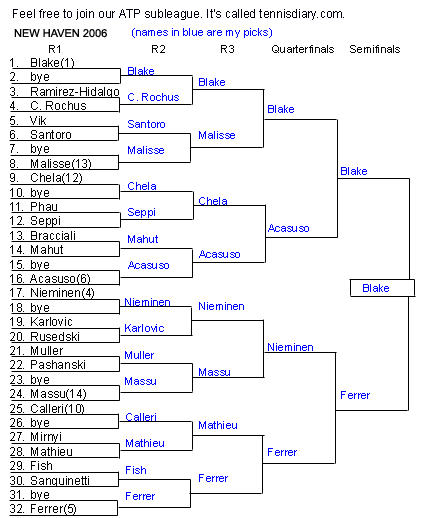
New Haven 2006: ATP fantasy league picks

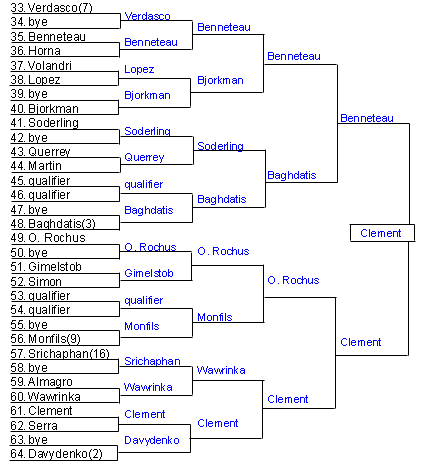
The last stop before the U.S. Open is the New Haven Pilot Pen Tennis tournament, a 48 player event paying the winner $84,000. Andy Roddick sewed up the U.S. Open Series Challenge with his win earlier today in Cincinnati. That means he gets twice the prize money for whatever round he reaches at the U.S. Open. Crashing out at the first round of the Open last year was bad enough for Roddick but he also won the Series Challenge going in so he left a lot of money on the table.

The hard court specialists have been playing in the U.S. for a few weeks so there aren’t a lot of those around for New Haven. There are three top ten players but only James Blake looks strong enough to win here. Nikolay Davydenko is weak on hard courts and Marcos Baghdatis is unpredictable unless he plays in a slam. I can’t remember a player since Pete Sampras who focused so strongly on the slams. I don’t think Baghdatis is in Sampras’ class and I don’t think it’s intentional on Baghdatis’ part. He loves playing to big crowds but hasn’t figured out how to play well week in and week out. He took a wild card here because he lost early in Cincinnati last week, ditto for Monfils who is average on hard courts.

The clay court specialists are getting in a tuneup before they make their perfunctory appearance at the noisy, overcrowded U.S. Open. The Open is not high on non-U.S. players’ lists of favorite slams, they prefer a more stately atmosphere and don’t always appreciate the scheduling at the Open. Prime time matchups with a U.S. player take precedence over the scheduling concerns of non-U.S. players whether they’re ranked higher or not.

Don’t confuse Julien Benneteau with those clay court specialists. At age 24, he’s making a late career push. He started the year at 160 and now he’s at 50 with a 13-8 record on hard courts. I have him in the semifinals because I don’t have confidence in Baghdatis.

Wawrinka beat Nalbandian last week but who knows what’s wrong with Nalbandian. He’s fallen off the map for some reason. Wawrinka started the year ranked number 54 and his current ranking is 54 so we can expect a third round finish at best because he’s consistently average.

Blake is a tough pick. He had a 6-2 record on indoor hard courts last year and there are a lot of indoor hard court tournaments left. You have to pick him this week because he won last year and this is his home tournament. If he does well then you have to pick him for the U.S. Open and you’ll be like everyone else, you won’t have a lot of players left to pick for the fall indoor season. Hopefully Nalbandian will wake up and start playing well.

My eight quarter-finalists are: Blake, Jose Acasuso, Jarkko Nieminen, David Ferrer, Julien Benneteau, Baghdatis, Olivier Rochus and Arnaud Clement.

You can read about Blake and Federer losing this week in Cincinnati here.
You can read about Nadal losing in Cincinnati here.


Becker – life in the ATP netherworld

This is life for the second and third tier tennis professional on the ATP tour.

Your ranking is down in the 200’s or 300’s, you’re a promising player and there is a tournament in your home country so you might receive a wild card entry. Scott Oudsema, a US player with a ranking of 390, received a wild card into the Countrywide Classic here in Los Angeles.

Sometimes, instead, those wild cards go to a high ranked player who decides to enter at the last minute. Andy Roddick was on a roll after reaching the final at Indianapolis last week so he decided to come to Los Angeles. Good thing really, this tournament has a long history with a storied list of winners including Rod Laver, Stefan Edberg, Pete Sampras, and Jimmy Connors, but they suffer in the current ATP schedule and Roddick’s star power should help their attendance. Top players don’t come to Los Angeles because they prefer to focus on the Masters Series events in Toronto and Cincinnati which are closer to the US Open.

Maybe your ranking is between 100 and 150 and there are two or three tournaments this week and one of them is a 64 or 48 player event. In a larger tournament, there is probably a place for you in the main draw.

If there’s a smaller 32 player event on your favorite surface, you have a good chance of getting through three rounds of qualifying and earning a first round match against Andy Murray. If you lose in the last round of qualifying and Andy Murray pulls out of the tournament– as he did this week – you can take his place as a lucky loser

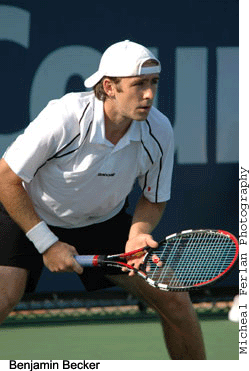
One of the players in that netherworld is Benjamin Becker, current ranking: 140.

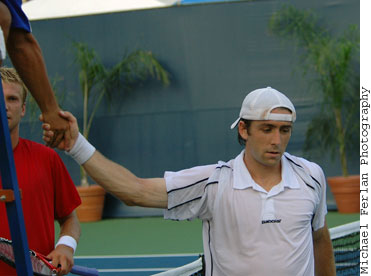
Becker is consistently making it into draws at ATP tournaments. He was in the regular draw last week at Indianapolis – a 48 player event – where he made it to the second round, and qualified into the draw here. As he played his first round match against Oudsema yesterday, I sat in the stands and watched him play.

Oudsema was the best draw Becker could have hoped for. Becker could have played Nicolas Mahut who is ranked number 64. After he lost his serve in the first set, my heart sank a little bit. It’s hard not to pull for a player who’s on the edge and trying to make it. The ups and downs seem more important than they do for a player who’s established and won’t suffer as much from an early loss. Hewitt lost in the first round to Paul Goldstein later in the day but I don’t worry about him.

Becker lost his serve in the second set also and lost the match 6-4, 6-4. After the match I asked what has improved most about his game and what his biggest weakness is. His answer was the much the same as you’d expect from a tennis player at any level of the game: mental focus and consistency.

I’m playing more aggressively, my serve is a little better, just a little bit of everything. …But today my mind wasn’t really in the match. I was lacking some aggressiveness I had last week.

Sometimes I feel like I’m mentally strong and sometimes I feel like I’m losing because of my mental weakness. The consistency is not there yet.

Becker’s goal is to reach the top 100 by the end of the year and get into the main draw at the Australian Open in 2007. He qualified into Wimbledon and won his first round match so it’s a realistic goal. Small victories mean a lot at this level. I asked him how it felt to walk out onto the grass at Wimbledon.

It felt pretty good. It gave me some confidence. I would have liked to win the second round but it was a great experience. It gives me motivation to do everything I can to get back there.

As for now, he’ll be at the next tournament, qualifying or getting into the draw on his ranking alone, and still trying to get to the third round.

Correction: Scott Oudsema won his wild card by winning the All-American Shootout competition on the Friday before the tournament started.

the Jimmy and Andy show

I was expecting Andy Murray to turn up this week at the Countrywide Classic here in Los Angeles, the second leg of the men’s side of the US Open Series. I also expected Brad Gilbert, reportedly Murray’s new coach, to put in an appearance. Then I read that Murray sat out his Davis Cup singles match against Israel with a brace on his neck and I quickly removed him from my fantasy team. Sure enough, Murray pulled out of this week’s tournament and Gilbert still hasn’t signed the contract because the deal involves running Britain’s juniors program and the two sides haven’t come to an agreement about how much time Gilbert will spend in England.

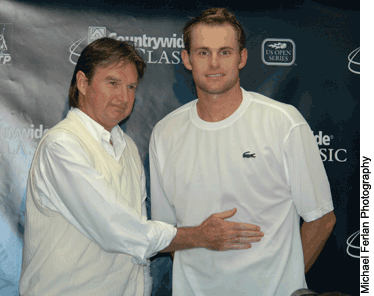
Who knews that something even better was in store for the US tennis world? Andy Roddick held a news conference in the small interview room at the Countrywide late this afternoon to introduce his new coach, Jimmy Connors. It was so crowded that some photographers never managed to squeeze into the room.

Roddick said he called Connors after the French Open and met with him at Wimbledon. Roddick and Connors decided to work together for four or five days in Santa Barbara before the Indianapolis tournament and see if they clicked. How civil is that? No long drawn out negotiations with every step appearing in the news as there has been with the Gilbert contract, just a short trial period.

Roddick made it to the final in Indianapolis and lost a close three set match to James Blake. After the match he said he had his confidence back. I had planned to ask him where he found it but now the answer is clear. He has a coach who believes in him. “It means a lot when someone who’s won as many tennis championships as Jimmy says, ‘You know what, I believe in you and I think you can really do some great things,'” he said.

I hadn’t really been paying attention to the talk about Connors coaching Roddick because Connors doesn’t seem like the coaching type. He’s not a friendly talkative guy like Gilbert, Connors is a recluse in comparison to other former tennis players, and he’s not soft-spoken like Dean Goldfine, Connors can be prickly and downright crass. Gilbert and Goldfine are former coaches of Roddick. But Connors might have something in common with Roddick’s current coach – his brother John.

Not as a brotherly figure but as a father figure. It’s not just that Connors is old enough to be Roddick’s father or that he kept calling him kid during the press conference, it’s that he reminded me of his mother. Gloria Connors taught Jimmy the game and she was the original tennis mother. She was Jimmy’s biggest fan and cheerleader. And that’s what Connors sounded like today, a cheerleader for Roddick. “People are begging to root for this guy,” he said of his new charge.

Connors hopes to give Roddick “a little bit of what made me what I was” and a big part of that was his fighting spirit, but what can he do about Roddick’s game? Thankfully he’s convinced Roddick to move forward on the return of serve. Gilbert originally moved Roddick further back because the return is a weak part of his game but neither of Roddick’s subsequent coaches has been able to coax him forward.

This is a hopeful start but we’ll see if Connors can get Roddick to a place where he can compete with today’s all court players. Murray, for one, has beaten him twice this year.

When a journalist asked Connors about instant replay he smiled and said, “That would have taken away a lot of my thing.” Which immediately brings to mind the time that Connors ran to his opponent’s side of the court and erased a ball mark before the umpire could come out and correct it. I assume Roddick won’t learn that kind of behavior from Connors.

Xavier Malisse has no such problem with instant replay. He’s become an expert at it. He used his first challenge in the fourth game of his first round match against Andre Agassi. Malisse had hit a backhand down the line that was called out. Everyone on my side of the court stood up, turned around and looked at the screen to see if the challenge would be upheld. It’s a cool thing, the challenge, because the crowd gets into it. Malisse won that challenge and broke Agassi in the game.

He gave the break back in the next game but he had something better up his sleeve. The set went to a tiebreaker and Malisse hit a shot down the line that went out and made the score 7-4 giving the set to Agassi. Agassi started to walk off the court but Malisse challenged the call. And won. A 7-4 score was now 5-6.

The tiebreak went back and forth, 7-7, 8-7, 8-8, until Agassi got his fourth set point at 11-10 and finally won the set on a Malisse error.

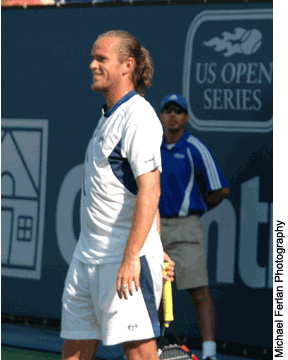
Malisse is a strange guy. He’s quick to anger and is known for losing his temper but his emotions go in one direction only. You don’t see him punch his fist and celebrate a good shot. There was a smile, as you can see here, after he won a challenge but that’s about it. And so it was a quiet second set as Malisse went down without a peep to lose the match 7-6(10), 6-0.

Malisse had lost the first set after winning a challenge and holding two set points. It must have killed him because all the energy drained out of his game in the second set. Maybe Malisse is content to be in the top twenty or thirty or maybe he doesn’t know how to channel his formidable emotions to help him win.

Malisse’s ATP profile doesn’t mention a coach. Perhaps he should call John McEnroe and see if he’d be interested in a coaching job. He could tell Malisse a thing or two about channeling emotions. It would be just like old times. Connors and McEnroe on the tour again.