Author Archives: nrota

Berdych, Baghdatis and the fight club

Marcos Baghdatis is an entertaining guy. He smiles a lot, bounces the ball between his legs before each serve and plays with the ballgirls and ballboys. He can afford to be care free. He burst onto the scene with an incredible run at the Australian Open dropping Andy Roddick, Ivan Ljubicic and David Nalbandian on the way to the final where he lost to Roger Federer. Federer is the only top ten player he’s ever lost too. His record is 6-0 against the rest of the top pack.

Tomas Berdych is in a different position. They might as well make a clothing line called “talented” and make players like Berdych wear it because that’s the label given to him when he is referred to. Usually when someone refers to a player as talented, it’s because they haven’t had the success expected of them. No one is calling Baghdatis talented, he’s just good.

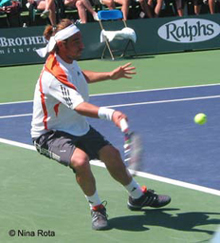
Watching this match today, Berdych doesn’t look like a member of the fight club and Baghdatis does.

Baghdatis and Berdych played each other in the fourth round today. After Baghdatis’ 6-4, 6-1 victory, I asked him why he’s had so much success against top ten players and Berdych hasn’t. Players today won’t say anything negative about another player’s game, they won’t even given an honest assessment. That’s why we’re so happy to have Martina Hingis back, she always speaks her mind. After beating Lindsay Davenport she called out the women’s tour for being less competitive now than it used to be. But Baghdatis did say, “…tennis is a tough sport. You have to be there every day and fight every day.”

Watching this match today, Berdych doesn’t look like a member of the fight club and Baghdatis does. Baghdatis didn’t answer my question directly but if we look at the last game of the match, we can answer the question for ourselves.

Baghdatis had won the first set 6-4 and he was up 5-1 in the second. This game could be the end of the match. On the first point Berdych hit an ace. At six foot five and 200 lbs., Berdych is big enough to hit a hard flat serve.

Berdych won the second point with a backhand slice approach that crossed the court at such a sharp angle it looked like a drop shot. Berdych has touch and a good an-all court game. You can see the talent everyone talks about.

But it’s Baghdatis who lunges at a good Berdych serve to get it over the net then wins the point when Berdych sends the ball long and it’s Baghdatis who runs wide for a very good approach shot and hits an ever better passing shot.

Finally, Berdych commits the ultimate sin. On his second game point, he hits a good approach shot then lets a Baghdatis lob float over his head without a swing only to see it land in the ad court corner. How can you let a playable lob go on game point? Membership in the fight club denied.

That must have been the last straw for Berdych because followed it up with two straight unforced errors for the game and the match.

Things could be worse for Berdych. He could have gotten all the way to a grand slam win only to find himself mired in a troubling slump. It’s hard to say slump when you’re the number three player in the world but Andy Roddick was absolutely beside himself after his loss to Igor Andreev. He lost the first set, 6-4, then dropped five set points in the second set before finally taking the tiebreaker. He had Andreev down 0-40 in the first game of the third set but couldn’t cash in then lost his serve at love.

In the press conference after the match, Roddick had an absolutely memorable meltdown. Between amusing references to Sideshow Bob from the Simpsons and Miss Cleo the psychic, Roddick seemed completely mystified and more than a little pissed. When asked to explain what happened at the beginning of the third set he answered, “I don’t know, I mean it’s only – you know. I’m the only one to blame. I don’t know what the hell I did. It was just like a blur.” Roddick was so angry during the match that he got a code violation for smashing his racket. Someone asked where his frustration was coming from and Roddick understandably responded, with frustration, “It’s coming from playing like shit. I don’t know what else you want?”

Roddick is the top American player and the number three player in the world, there is a mountain of pressure on him to maintain that ranking and perform well in big tournaments. Letting off steam under that pressure is not such a bad thing if you feel better afterwards. But it’s not clear that Roddick’s problems are mental. On one of his volley attempts, his footwork was so awkward that he ended up lunging at the ball instead of hitting a smooth volley. If he plays within himself, and that means hanging out on the baseline most of the time, his true ranking might be further down the top ten.

Andre and Lindsay: who’s got next?

As I was watching Lindsay Davenport play Martina Hingis in their fourth round match at Indian Wells today, I couldn’t help but think about the state of American women in the game at the moment. Maybe it was watching Andre Agassi lunging at Tommy Haas’ serve last night but the thought crossed my mind that Davenport might not be around all that much longer.

Hingis has won 19 out of 25 matches since returning from a three year layoff but she was not the story during this match even though she won it, 6-3,1-6, 6-2.

The match rested on Davenport’s racket but Davenport couldn’t keep the ball in play. Again and again she set up a winner and hit the ball wide or long. It wasn’t like Agassi last night, she was getting to the ball, but she wasn’t putting it in the court. She had twenty-one errors in the first set alone.

Everybody is always trying to get rid of you long before you’re ready to go. Davenport could be having a bad day. She played well this year in the two events she entered reaching the quarters at the Australian Open and the semis in Dubai.

And, no, she’s not ready to go just yet but in the post-game interview she revealed that she was diagnosed with a bulging disc last week. She wants to play in Miami, the next tour event, but then she plans to take four to six weeks off. That puts her smack dab in the middle of the clay court run-up to the French Open. She should consider following Agassi by skipping the entire clay court season. That might be too much of a concession for Davenport’s pride but surely playing short points on hard court and grass is better rehabilitation for a bulging disc than hours running around on red clay.

Meanwhile, back to those American women. The men’s side is not great but it’s o.k. Roddick should be around for a while to come, James Blake is at number 14, we hope that Ginepri rights himself and we also hope that Donald Young wins a match on the tour some time soon. The women’s side? Well, there’s part-time Venus Williams at number 10 then we’re down to Amy Frazier, who is 35 years old, at number 47. Laura Granville and Ashley Harkleroad at 52 and 78 are both in their twenties but they’ve been ranked higher in the past than they are now. Harkleroad lost to Davenport 6-0, 6-0 in the second round here and Granville lost to Davenport 6-4, 6-0 in the third. That leaves us with Serena Williams at 58 and Lisa Raymond at 68. Serena is a television star and Raymond is thirty-two years old.

That is a bleak picture.

Marat Safin: out of body experience

They’ve been rotating the DVD, Lleyton Hewitt – The Other Side, recently on The Tennis Channel. From my viewing, Hewitt is who he is regardless of how you portray him. He’s a brash, “f.u. mate, I’ll tell you what I’m going to do” kind of guy who scratched and clawed his way to the Australian Final last year against Marat Safin. What’s wrong with that? On the DVD, you see Hewitt warmly congratulating Safin after Safin beat him. Safin is apologetic and humble, he looks puzzled at himself.

That’s because, much of the time, Safin is his own unquiet witness. He can’t control his temper and seems bemused at his own actions. It’s like he’s having an out of body experience. You expect to tune in to ESPN and see an extra little body with wild hair looking down at Safin while throwing its hands up in the air and repeatedly crying, “What is he doing?”

You expect to tune in to ESPN and see an extra little body with wild hair looking down at Safin while throwing its hands up in the air and repeatedly crying, “What is he doing?”

Safin is back on the tour after a seven month layoff due to a knee injury and his third round opponent here at Indian Wells is his fellow Russian, Nikolay Davydenko. Davydenko is the anti-Marat in a number of ways. Safin is solidly build with wild hair, it’s tied into a Samurai topknot at the moment, who is likely to explode at any moment; Davydenko is slight and balding and seldom shows much emotion except to stare at a linesperson and perhaps brood a bit when he’s unhappy with a call. Safin has a big game, you hear a huge “thud” when he hits the ball, and his consistency is, well, inconsistent; Davydenko is a steady hitter and excellent defensive player who doesn’t give points away. Safin has a big serve that can get him out of trouble when necessary; Davydenko does not.

It doesn’t help Davydenko that most Russians still consider Safin their top player despite the fact that Davydenko is ranked number five in the world. Poor guy, he doesn’t even get respect from me. I’m interested in Safin here, not him.

Davydenko is not only steady but he’s smart. With Safin serving at 3-3 in the first set, Safin hit three straight errors to give Davydenko two break points. Many players force the issue resulting in errors that let their opponent back into the game. Knowing that his opponent is Safin, Davydenko kept the ball in play until Safin made another error and lost his serve.

After two more errors to start the next game, here it comes. Safin smashes his racket and gets a code violation for racket abuse. Maybe Safin could find a twelve step group for racket abuse. Still, after a double fault and a few loose shots by Davydenko, something he can’t afford, Safin got the break to get back on serve. For a few strokes. On his third straight error in the next game he screamed at himself in Russian. It seemed to bother Davydenko as much as Safin. They exchanged breaks for the last five games of the set to get to the tiebreaker with only one Safin explosion, a ball hit as hard as he could off the backboard behind his opponent expertly missing the ballgirl and linesman. No casualties, no code violation.

Despite his outbursts, Safin thinks that his layoff helped him. “I solved a lot of problems that I had outside of tennis, ” he said after the match. “Actually, it was the right thing. It happened to me at the right time.” If this match is any indication, he’s right. Safin kept the ball in play long enough during the tiebreak to outlast Davydenko and take the first set then he survived a titanic service game at the beginning of the second set in which he faced five break points.

He lost the second set on a break but that may have come with some bad luck. Facing two break points at 1-2, he thought his serve was incorrectly called out. No outburst, he just walked up to the net and pleaded with the lineperson, “Sweetheart, you can’t miss these balls, it’s very important for me.” Fair enough.

He was down a break in the third set too but fought back to break Davydenko twice in a row to win the match, 7-6(5), 3-6, 6-4.

Andre Agassi had the same experience with his mid-career break. He resolved some of the psychological issues in his life and went on to become a tennis ambassador and all-round good guy. I don’t expect that of Safin. Not to take anything away from Andre but it’s more fun to pick apart a tortured soul. I just hope he’s improved enough to join Roger Federer, Rafael Nadal and Andy Roddick in a dynamic top four that would give majors the buzz they deserve.

Indian Wells 2006: covering up flaws

It’s a good thing I can sit inside in the media center overlooking the stadium here at Indian Wells. This is the desert, it’s next to Palm Springs, but it’s been cold and rainy. A short poll of the locals found one person who has lived here for twenty years and had never seen snow this low on the surrounding mountains. This is not the place where you expect to sit in the your jacuzzi looking out at the snow.

Everyone is here, nine of the top ten men and three of the top five women and, most exciting of all, there is a good chance we’ll see a Rafael Nadal – Roger Federer final for the second week in a row. Welcome to the Pacific Life Open, sometimes called the fifth major. It’s one of only two tournaments that run for two weeks with both men and women outside of the majors. The other is the next event on the calendar, The Nasdaq 100 in Miami. Both of these events are Masters Series tournaments. Three times each year, Masters Series events follow each other on consecutive weeks. Hell, why not make the entire schedule the Masters Series and make the top players turn up every week.

I’m sitting here ignoring the Lleyton Hewitt – Rainer Schuettler match unfolding beneath me but I should be paying attention because Hewitt and Schuettler are playing a terrific three set match. Hewitt broke Schuettler to go up 3-2 in the third then had triple match point on Schuettler’s serve but couldn’t close out until the next game.

If life isn’t hard enough for Israelis, the tennis world isn’t treating them that well either. Last week in Dubai, players were criticized for taking large appearance fees while ignoring Dubai’s seamy reputation for laundering terrorist’s money and hosting the sex slave industry. That’s bad enough but Dubai also refuses to issue visas to those holding Israeli passports. Earlier this year, Sania Mirza was scheduled to play doubles with Israeli Shahar Pe’er at the Bangalore Open but changed her mind because because Indian Muslim groups threatened protests. Newspapers reported that Mirza told Pe’er, “It’s best that we don’t play together this time to prevent protests against my cooperation with an Israeli. There is no reason to arouse their ire (Muslims).”

Evidently Mirza also felt pressure to play doubles since she went on to to play with Liezel Huber and win the doubles event at Bangalore. One thing that sets her apart from other young players is her combativeness, she’s seldom out of a match as you’ll see below, but she could have shown some of that towards her fellow Muslims. It’s not the easiest time to be a Muslim either but Mirza should have stood up for Pe’er.

Let’s check in on Mirza to see is if she is still impatient and inconsistent. She has a sledgehammer for a forehand and a good serve but she goes for winners far too often. Today she played Elena Dementieva in her third round match. Dementieva has her own problems. Everyone loves her game but that serve. The way her career is going, it will be defined by misadventures in serving. “Dementieva, I remember her, she was a great fighter but couldn’t hit the side of a barn with her serve.” Good thing she’s a fighter, look at this line: she had 18 double faults and was broken 8 time. And she won the match!

Twice Dementieva had three double faults in a row. The first time came in the first game in the second set – Mirza had won the first set by giving up only two breaks to Dementieva’s three. Mirza pounced on her next serves by hitting big returns but all she did was make errors and she let Dementieva win the game. Mirza was so discouraged she gave up two breaks and was down 0-4. Dementieva’s second triple helped Mirza get back to 4-5 but that’s as close as she’d come. The third set had the same pattern. Mirza was down 5-1 and fought back to 4-5 but lost the set and match, 7-5, 4-6, 4-6.

I’d like to switch over to a parallel universe where Dementieva had a consistent serve and Mirza focused on strategy a little more and power a little less. Then we’d be looking at an excellent match. As it is we’ll have to settle for for two flawed fighters slugging it out. One of them, Dementieva, a top ten player successfully covering up her flaws and the other, Mirza, trying to figure out how to play the game.

Barry Bonds – the final judgment

Steroid use in baseball has run its course, all that’s left now is to uncover the lies. Jason Giambi has adjusted to life without steroids, Mark McGwire is long retired, Rafael Palmeiro is gone and Sammy Sosa refused a non-guaranteed contract offer from the Washington Nationals this year.

That leaves Barry Bonds. And now its time for him to go too.

Excerpts from the book Game of Shadows, by Mark Fainaru-Wada and Lance Williams, show a clear pattern of steroid use by Bonds. Two employees of BALCO, including owner Victor Conte, testified in front of a grand jury that Bonds received steroids from BALCO starting in 2003. Bonds’ girlfriend at the time, Kimberly Bell, testified in front of the grand jury that Bonds told her he started to take steroids after the 1998 season.

Some people think that Bonds should suffer the same purgatory as Pete Rose – banishment from baseball including the Hall of Fame. Others are unhappy because Bonds is getting a lot of hate while Mark McGwire and Sammy Sosa are fading into the limelight without the bitternes displayed towards Bonds.

McGwire lost a lot of respect with his cowardly response at the congressional hearings into steroid use in baseball – he refused to answer when asked if he used steroids – but the evidence of his use was a bottle of androstenedione, an over-the-counter testosterone supplement, openly displayed in his locker. Rafael Palmeiro gave us the most dramatic denial at the hearings then tested positive for the steroid stanolozol during the following season. Congress looked into perjury charges against Palmeiro but baseball didn’t test for steroids before the hearings so no charges were filed.

You could say that Bonds should be judged by the same standard as McGwire, Bonds has never tested positive for a banned substance after all. Many times, though, it’s not the crime but the coverup that gets you. Life would have been much easier for Bill Clinton if he’d just said, “I did have sexual relations with that woman.” Adultery may not be a crime but lying about it can get you into a lot of trouble. It appears that Bonds lied to the grand jury by denying that he used steroids. Bonds may have been unlucky to get involved in the BALCO scandal but so was Giambi. It’s hard to argue that Bonds is getting unfair treatment when you consider that Giambi admitted using steroids in front of the same grand jury. It pays to tell the truth.

You could also say that it’s not baseball’s job to police its players off the field but that’s like saying that Marion Jones was involved in off the field activity went she went to BALCO. Bonds went to BALCO so that he could break baseball records. Baseball commissioner Bud Selig has made a career out of sticking his head in the sand. He had to be shamed into instigating steroid testing by congress and further pressured by congress to increase the penalties for positive tests. He’s getting the same pressure to penalize Bonds.

The best thing for Selig to do is to give Bonds a suspension that is long enough to effectively end his career. Barry lovers will be unhappy because Bonds will lose the opportunity to break Babe Ruth’s home run record and Barry haters will be unhappy because Bonds will still get his first round ticket into the Baseball Hall of Fame. But it’s a fair compromise and it serves a very important purpose: it brings the steroid era to a close and allows baseball to move forward.

Baseball will not have to pretend to celebrate Bonds breaking Ruth’s record and Barry will be put out of his misery because we won’t have him to kick around any more.