Author Archives: nrota

U.S. Open 2006: ATP fantasy league picks

I’m happy to report that our favorite up and coming player, Benjamin Becker, is into the U.S. Open draw as a qualifier. Since his first round loss at Los Angeles he’s climbed from number 140 to 112 by playing well in challenger events.

I don’t really expect Nadal to be in the final but I can’t see anyone who can beat him.

It was crazy last week in New Haven. Blake went out in the second round after throwing away five match points while Nikolay Davydenko got to the final. When was the last time Davydenko was in a final on outdoor hard court – let’s see, Adelaide in 2003.

Yep, it’s time for the U.S. Open again. Is Blake ready to duplicate his exceptional run to the semifinals in last year’s Open? Doesn’t look good. If Blake gets to the second round he could face Tamuraz Gabashvili who beat him in their only previous meeting. If Blake gets to the third round he could face Agustin Calleri who also beat Blake in their only meeting, is also in the New Haven final, and is 17-3 in his last twenty matches. If Blake gets to the fourth round he could face Tomas Berdych. Blake beat him in Washington last year but this year I don’t think so.

If Berdych and Dimitry Tursunov meet in the third round, it will be flat-shot heaven with two of the harder hitters in the game. Berdych is hard to classify. This year his best results have been on clay and grass while he’s been slightly better than average on hard court. I’ve been all over him because he hasn’t played top ten players very well but he’s only 21 years old and it may take his game longer to develop because he can play on all surfaces well. Berdych has a slightly better record than Tursunov so I have him in the quarterfinals.

I planned to save Nalbandian for the slams because he’s usually a fixture in the semifinals, but if Marat Safin makes it to the second round against Nalbandian that could be trouble because Safin has a 5-1 career record against him. Olivier Rochus has beaten Safin both times they’ve met this year. Not that Safin is in much shape to go far. His own coach, Peter Lundgren, recently took a shot at Safin about his conditioning.

If you have any David Ferrer uses left in the ATP fantasy game, consider that Robin Soderling is 3-0 against him on clay, grass and hard court.

I have Gasquet over Ljubicic in the fourth round. The best Open Ljubicic had was the third round last year. Where he lost to Gasquet.

Fernando Gonzalez against Andy Murray in the fourth round is hard to pick. If Gonzalez doesn’t unravel emotionally he could take it, particularly since Murray is getting tired from going so deep into tournaments, but I’m going to guess that Brad Gilbert, Murray’s coach, can maneuver his client around Gonzalez. How often do we ascribe a victory to a coach? Not only that but Murray has been to the finals, semifinals and the quarterfinals since hooking up with Gilbert so I have him in the semis where he loses to Roger Federer.

Now is the time to use Marcos Baghdatis, the grand slams are his performance space. He got to the final of the Australian Open this year and the semifinals at Wimbledon. I just realized he’s up to number eight in the world, that’s what happens if you play the slams well. Can he beat Gasquet if they meet in the quarterfinals? Since it’s a slam I’m going to say yes but I expect Gasquet to join Baghdatis in the top ten one day soon.

I don’t really expect Nadal to be in the final but I can’t see anyone who can beat him. I suppose Baghdatis is a good candidate but Nadal has beaten him on hard court and grass this year. Federer could lose to Berdych, maybe, but Murray’s not in good enough condition to beat Federer.

My eight quarterfinalists are: Federer, Berdych, Tommy Haas, Murray, Baghdatis, Gasquet, Soderling and Nadal. Robredo might be worth a try too since Soderling and Robredo are in the weak part of the draw.

How many of you think it will be a Federer-Nadal final? How many of you think Baghdatis knocks off Nadal? Will Nadal get that far? Whaddya say?

You can read last week’s picks here.
You can read about Marcos Baghdatis at the Australian Open here.


The WTA and Davenport: biting the hand that feeds you

Imagine this: you’ve been on the WTA tour for thirteen years, won three grand slams, fifty-one singles titles and an Olympic gold medal. Early in the year you’re diagnosed with a bulging disk and while you’re recovering you get a concussion from a freak injury. You finally decide you’re ready to play the U.S. Open and ask for a wild card to San Diego and Montreal to play a few tune-ups before the Open – wild cards can be given to top ranked players if they decide to enter a tournament past the entry deadline. The head of the WTA, Larry Scott, says no, you can’t have one, you’re not eligible for a wild card. Meanwhile the Montreal tournament is desperate for players since Maria Sharapova dropped out leaving only four of the top ten players entered

The WTA has a huge problem on its hands. It can’t give tournament directors the top players they need to sell their tournaments. Too many players are injured or they’re too tired to play. The schedule is out of control and the level of play is so inconsistent that a player who retired three years ago due to a foot injury, Martina Hingis, looked at the field and decided that it’s not as competitive as it was before she retired. She returned at the beginning of the year and eight months into the season she’s in the top ten.

If he let her bend the rules, how could he get a handle on those unruly players like Sharapova who skipped Montreal because she was tired?


Lindsay Davenport is the player who had the bulging disk and the concussion and when she was ready to rejoin the tour and play in San Diego, Mr. Scott decided to use her as an example. If he let her bend the rules, how could he get a handle on those unruly players like Sharapova who skipped Montreal because she was tired?

What rules are we talking about here? WTA players sign a Player Commitment Contract (PCC) each year which commits a player to a minimum number of tournaments plus certain designated tournaments. Davenport didn’t want to sign a PCC for 2006 because she wasn’t sure she could play the minimum number of tournaments. According to rule II.D.2.c., one of the penalties for not signing a PCC is that she’s not eligible for wild cards.

There was another penalty if you want to call it that. Players receive compensation for signing the PCC. In Davenport’s case, because of her high ranking, she would have received $500,000 if she’d signed a PCC for 2006. That means she was willing to forfeit half a million dollars to play a reduced schedule. Surely that’s punishment enough. By the way, Davenport is about half a million dollars from being the top prize money winner in women’s tennis history.

Wait a minute, you might ask, isn’t there a veteran’s exception rule or something like that? Indeed there is. Rule II. A. 2. allows the tour to confer Gold Exempt Emeritus Status on a player who has won a minimum of three slams or titles, has been ranked number one at least once in her career and has “demonstrated an exceptional level of commitment and excellence on the Tour over an extended period of time.” Such a player can receive unlimited wild cards.

Davenport satisfies all of those conditions and more, so what’s the problem? I left one condition out: “The player has provided at least 14 years of service to the Tour.” According to Liz Robbins’ interview with Davenport in the NY Times earlier this week, that rule was put in so that a semi-retired Monica Seles could play on the tour. I guess the tour felt that they owed her that much.

Davenport is owed that much too. Never mind that she loves the game so much that she’s dragged her retirement out for three years. After the 2003 Wimbledon, she said she might have played her last singles match because she had to take cortisone shots for a foot problem just to get on the court. After that injury she said that she’d retire rather than deal with another significant injury yet here she is after a bulging disk and a concussion. Meanwhile, she won six tournaments last year and played in two grand slam finals, the second one a heartbreaking loss to Venus Williams in one of the best Wimbledon finals ever played.

Sharapova was fined $150,000 for skipping Montreal. That’s fair enough, it sends a message to other players that they can’t pull out of tournaments at the last minute. But what sense does it make to penalize Davenport, she wants to play in tournaments for heaven’s sake, she’s not pulling out. Clearly rule II.A.2. applies to Davenport’s current situation, she’s in semi-retirement after a long and illustrious career, and she should have received the exemption.

Davenport got into the tournament this week in New Haven through regular entry – she’ll play the final against Justine Henin-Hardenne tomorrow – but she should have had her pick of tournaments. She deserves to be treated the same way she’s treated tennis, with great love and appreciation.

You can read about similar problems with WTA players pulling out of a tournament here.

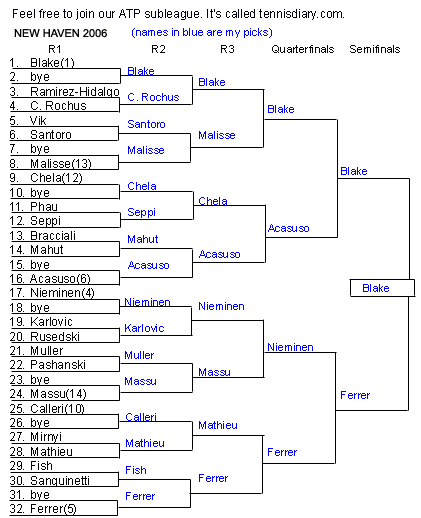
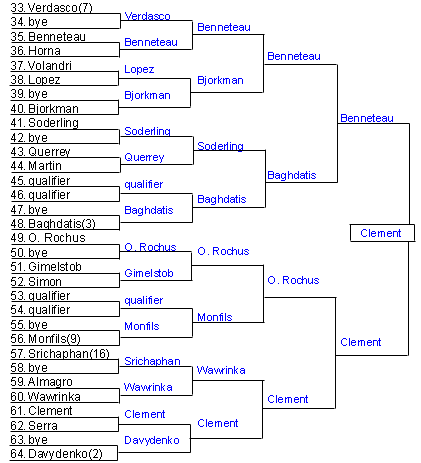
New Haven 2006: ATP fantasy league picks

The last stop before the U.S. Open is the New Haven Pilot Pen Tennis tournament, a 48 player event paying the winner $84,000. Andy Roddick sewed up the U.S. Open Series Challenge with his win earlier today in Cincinnati. That means he gets twice the prize money for whatever round he reaches at the U.S. Open. Crashing out at the first round of the Open last year was bad enough for Roddick but he also won the Series Challenge going in so he left a lot of money on the table.

The hard court specialists have been playing in the U.S. for a few weeks so there aren’t a lot of those around for New Haven. There are three top ten players but only James Blake looks strong enough to win here. Nikolay Davydenko is weak on hard courts and Marcos Baghdatis is unpredictable unless he plays in a slam. I can’t remember a player since Pete Sampras who focused so strongly on the slams. I don’t think Baghdatis is in Sampras’ class and I don’t think it’s intentional on Baghdatis’ part. He loves playing to big crowds but hasn’t figured out how to play well week in and week out. He took a wild card here because he lost early in Cincinnati last week, ditto for Monfils who is average on hard courts.

The clay court specialists are getting in a tuneup before they make their perfunctory appearance at the noisy, overcrowded U.S. Open. The Open is not high on non-U.S. players’ lists of favorite slams, they prefer a more stately atmosphere and don’t always appreciate the scheduling at the Open. Prime time matchups with a U.S. player take precedence over the scheduling concerns of non-U.S. players whether they’re ranked higher or not.

Don’t confuse Julien Benneteau with those clay court specialists. At age 24, he’s making a late career push. He started the year at 160 and now he’s at 50 with a 13-8 record on hard courts. I have him in the semifinals because I don’t have confidence in Baghdatis.

Wawrinka beat Nalbandian last week but who knows what’s wrong with Nalbandian. He’s fallen off the map for some reason. Wawrinka started the year ranked number 54 and his current ranking is 54 so we can expect a third round finish at best because he’s consistently average.

Blake is a tough pick. He had a 6-2 record on indoor hard courts last year and there are a lot of indoor hard court tournaments left. You have to pick him this week because he won last year and this is his home tournament. If he does well then you have to pick him for the U.S. Open and you’ll be like everyone else, you won’t have a lot of players left to pick for the fall indoor season. Hopefully Nalbandian will wake up and start playing well.

My eight quarter-finalists are: Blake, Jose Acasuso, Jarkko Nieminen, David Ferrer, Julien Benneteau, Baghdatis, Olivier Rochus and Arnaud Clement.

You can read about Blake and Federer losing this week in Cincinnati here.
You can read about Nadal losing in Cincinnati here.


Nadal loses and Roddick joins the Connors fight club

Could Nadal be more like Borg than we thought?


There are four players left in the draw at the Masters Series event in Cincinnati but it seems rather empty because Roger Federer and Rafael Nadal are gone. Federer forgot to show up for his second round match against Andy Murray and now Rafael Nadal is gone. Quick, guess who beat Nadal…. Nope, you’re wrong, it wasn’t Federer and it wasn’t Tomas Berdych and it wasn’t James Blake. It was Juan Carlos Ferrero.

I told you last week how to beat Nadal after Berdych beat him in Toronto. Ferrero is not as tall as Berdych – Berdych is 6’5″ which makes Nadal’s high kicking balls less of a problem – but he got the two most important parts of the strategy correct: 1. stay up on the baseline 2. attack, attack, attack.

Ferrero didn’t attack the net but when he had an opening he flattened out his stroke and hit the ball as hard as he could. If you rush Nadal you can force him into errors because it takes him time to wind-up for those big topspin shots.

Nadal made a very un-Nadal like mistake: he played the big points badly. Up 6-5 in the first set, he missed a swinging volley that would have given him a break point. In the first set tiebreak he double faulted to go down 0-4 and double faulted again to give Ferrero set point. In the second set tiebreak, yes it was that close, Ferrero helped himself with a service winner and an ace but Nadal made two big ground stroke errors. Ferrero was into the semifinals with a 7-6(2), 7-6(3) win.

Could Nadal be more like Borg than we thought? Borg won six French Opens and five Wimbledons but never managed to win a hard court US Open. Nadal got to the final at Wimbledon this year after winning the French Open but he’s inconsistent on hard courts. Last year Nadal won a Masters Series event on hard court in Montreal and the Madrid Masters Series event on the faster indoor court but he hasn’t reached the final in any of the four hard court Masters Series events this year.

On grass you have to come to the net and Nadal did that at Wimbledon but he hasn’t yet figured out how aggressive he needs to be on hard court. He came to the net three times in the first set today, not nearly enough. He let Ferrero dictate the points.

Borg had the game to win the US Open, that wasn’t the problem. He hated the U.S. Open because he didn’t like to play under the lights and he also thought the U.S. Open organizers gave the U.S. players favorable scheduling. They did. Despite Borg’s protests, they scheduled him against U.S. players at night.

So the Borg-Nadal comparison doesn’t hold. Borg had the game to win the U.S. Open and Nadal will probably figure out how to play hard courts. But that doesn’t mean Nadal will win a U.S. Open. He may not because the competition is greater. There aren’t many players who play well on grass but there are a number who excel on hard court.

Federer sounded like he was protecting his ranking points in Cincinnati. He said that “it’s just basically something of the impossible” to win consecutive Masters Series events because you play twelve matches in thirteen days. His goal was to win a few early rounds. You lose ranking points if you go out earlier in a tournament than you did the year before but Federer didn’t play this event last year so his early loss didn’t cost him anything. He couldn’t stay home without incurring a large fine since Masters Series events are mandatory. Maria Sharapova skipped the women’s event in Montreal this week because she said she was tired and got a $150,000 fine. She should have done the same thing as Federer, turn up with few expectations, lose early then go home.

Federer and Nadal may still be tired from reaching the finals at the French Open and Wimbledon but Borg won the French Open and Wimbledon back to back three times so what’s their problem? Borg had it easier. He only played the Australian Open once, he lost in the third round, and he didn’t have to play consecutive Masters Series events against most of the top ten players three times a year. Federer won Indian Wells and Miami back to back this year and last year but they are two week Masters Series events so you get twice as much rest. Toronto and Cincinnati are one week events.

After the 2008 Olympics, the ATP schedule will be revamped and the Masters Series format will change. As I’ve said many times, they should keep these events because all of the top players turn up, they just need to get rid of the consecutive one week version.

“Once you get on there, friendship ceases and, really, afterwords it’s really the same.”


Two weeks ago Jimmy Connors, Andy Roddick’s new coach, was interviewed by Jim Rome on Rome’s radio show. Connors was his usual combative self. He complained about the media’s treatment of Roddick. He said that the media builds players up then tears them down just as quickly the moment they falter. “I’m tired of seeing him get hit with a heavy sledgehammer all the time,” were Connors’ exact words. Roddick is getting criticism because his ranking has fallen and he hasn’t won a tournament this year.

I’m happy to see Connors go to bat for his boy but I was even more interested in something he said later in the interview:

There’s still a little bit of something maybe that I can give to him that was a big part of what I did.That kill-or-be-killed attitude …was something that I took onto the court with me and I left the court with that too. …Once you get on there, friendship ceases and, really, afterwards it’s really the same. It’s tough just to throw that away and say, o.k., every thing’s fine now.

Connors took his tennis matches personally and he took that attitude off the court and into the locker room. He had few friends on the tour outside of his very small entourage. Today’s ATP tour is different. It’s a point of pride with Federer that he’s friendly with all of the players. Lleyton’s Hewitt’s combative behavior is viewed as abnormal. Roddick takes pride in his sportsmanship. In the 2005 Rome Masters tournament, he had triple match point against Fernando Verdasco when Verdasco hit a double fault. Roddick said that the serve had been good and refused to accept the point. Verdasco saved his serve and went on the win the match.

However, Roddick is an emotional guy and he will get into it with players on occasion. In the first set of his quarterfinal match with Andy Murray last night, both players hit balls at each other early in the first set. After Roddick ducked Murray’s missile, he pointed his finger up to indicate that Murray’s ball was out, an obvious attempt to get under Murray’s skin. Later in the set, Roddick ran down a Murray lob, turned on it and hit a blistering forehand past Murray at the net then put his finger up again to add a bit more attitude to the mix.

I like this. Roddick plays better when he’s emotional and aggressive and we can assume that Connors gets some of the credit for the attitude adjustment. Roddick’s overall game is more aggressive. He stays on the baseline instead of miles behind it and he continues to come to the net no matter how awkward it has looked at times. In the second set, Roddick rumbled up to the net grunting like a rooting pig to get to a drop shot. Not pretty, but it worked. He put the shot behind an approaching Murray and got a break point.

Roddick won the match, 6-3, 6-4. He had some luck because Murray was exhausted from playing too many matches. But sometimes you need a break to turn things around and when it arrives, you’d better take advantage of it.

There’ve been more than a few breaks this week. A Federer loss, a Nadal loss, an exhausted Murray. Let’s see who else takes advantage.

You can read How To Beat Rafael Nadal here.
You can read about the Roddick and Connors partnership here.

tales of instant replay

Instant replay has come to the US Open Series and last week in Los Angeles, Xavier Malisse embraced it. He used his first challenge in the fourth game of his first round match against Andre Agassi last week. Malisse had hit a backhand down the line that had been called out. Everyone in my section stood up, turned around and looked at the screen to see if the challenge would be upheld. It’s a cool thing, the challenge, because the crowd gets into it. Malisse won his challenge and broke Agassi in that game.

He gave the break right back in the next game but he had something better up his sleeve.

Agassi was up 6-4 in the first set tiebreaker, it was set point. He hit a hard forehand down the line and Malisse responded with a backhand that was called long. Agassi walked off the court, the set was over. Except that it wasn’t. Malisse challenged the call and won the challenge. What had been a 7-4 score was now 6-5. Agassi finally won the tiebreaker, 12-10, but not until (yuck) Malisse had had two set points of his own.

Malisse lost the second set 6-0. (check this). The moral of the story? [blockquote]You can win a challenge that saves a set but you can still lose your mind. I suppose Malisse’s meltdown came from the disappointment of having snatched a set point away from Agassi, getting two of his own set points, and still not being able to win the set.

And here is the problem with instant replay. It gives you a great deal of satisfaction if you win a challenge but it doesn’t pump you up anywhere near as much as arguing a line call. You can psyche yourself up and your opponent out by making a big deal out of line calls. John McEnroe and Jimmy Connors made an art out of it. Arguing about a line call was the prime method of unnerving an opponent who had somehow managed to snatch the momentum of the match. First of all you can delay the game to stall your opponent’s momentum. And if you’re very good, you can piss them off and take them out of their game. [blockquote]You don’t think McEnroe or Connors really thought those balls were out, do you?

Not that instant replay stops everyone from arguing. Marat Safin hit a ball that was called good in his (first round?) match with Mardy Fish in Los Angeles. Fish challenged the call but the replay screen wasn’t working. The Hawkeye booth confirmed that the original call was correct and Fish lost his challenge [include image of Fish arguing here] but Fish wasn’t having it. If he couldn’t see it, it didn’t happen. (who won the match? If Fish was losing, maybe he was trying to psyche himself up).

Some people weren’t argumentative enough. Fernando Gonzalez and Andre Agassi were on serve at 3-2 in the second set of their third round match in Los Angeles (fix this because everything but Goldstein is in LA). Gonzalez was up 40-0 when he hit a forehand that was called out but it clearly landed on the line. If he’d challenged it, he could have won the game. But he didn’t and he ended up getting broken. He won the match but it took him three sets to do it. It was 110 degrees on the court, he might have saved the second set and a lot of his energy if he’d used that challenge. The next day(?) he lost to Dmitri Tursunov(?). Maybe he was tired, who knows.

So here are the two aspects of instant replay that need attention. One: who is allowed to say whether it’s out or not? Can the coach signal it? Can the players ask the umpire his opinion? Two: if the chair umpire knows that Hawk Eye messed up – the image is rotated for instance – they should then be able to make take that into consideration and make the correct call.

Edit this with Terry and submit to Tennis.com?
Just because you win a challenge doesn’t mean you can’t throw a tantrum. In the doubles finals at Indianapolis two weeks ago, Paul Goldstein and Jim Thomas challenged a call out in their doubles final against Andy Roddick and Bobby Reynolds. They won the challenge but Goldstein was not at all happy because the chair umpire ruled that the point should be replayed because the linesperson made the call early preventing the opposing player from playing the ball. Goldstein was irate because the ball was clearly out of reach. He chopped the net with his racket and kicked the base of the umpire’s chair. If it had been Xavier Malisse or Marat Safin, the chair umpire would have docked them a point for chair umpire abuse. Goldstein’s such a nice guy that he got away with it.

Does instant replay take the tension out of the game? Would we prefer to see Jimmy Connors yell and scream. It does affects players psyche. Then, with online coaching, is more tension gone or added? First we take away an opportunity to be irate and get yourself going then we bring down a coach so you are less likely to throw away a second set at 6-0 because you wer…

We’re slowly draining tension out of the game. What will players do to regain it. Take baiting(?) lessons from Marco Materazzi… You do realize that we could be encouraging much worse behavior by taking away arguing over a line call. Players might have to resort to harrassment or inciting fans to throw … I hesitate to mention this because it’s disgusting but soccer fans evidently pee into empty beer cups (the men presumably though I did once ride the Green Tortoise[link?] – a hippie bus – from Boston to New Orleans for Mardi Gras and used a funnel at the front of the bus for emergency peeing) and throw piss bombs on opposing players as they run into their locker room.

Don’t worry though, because Hawkeye doesn’t always work.

In the first set of the Bryan brothers semifinal match, they challenged a call and it took so long to come up on the screen that they said, forget about it, we’ll just move on. And they did.

During a quarterfinal match between Robbie Ginepri and Dominik Hrbaty, Hrbaty had a fault called on him and he challenged it. The replay verified that the ball was good, it was not a fault. But Ginepri complained because the image on the screen was flipped 180 degrees. That made the ball look like it was good even though it was actually out if the image had been oriented correctly. Unbelievably, the umpire upheld Hrbaty. Ginepri was not amused. He got to the tiebreaker in the set but lost it badly (7-0?) and never recovered. I guess arguing has its limits. [do I have an image of Ginepri arguing?]

This week’s instant replay stats as of 5-4 in the first set of the final (check my record of the match to see if there were challenges in the rest of the match). 70 challenges, 32 overturned calls, 45% overturn rate.

During the week in Los Angeles, players won challenges about 45% of the time so they were right almost half the time. Next week in Los Angeles players were winning only 33% of their challenges by the time the semifinal rolled around. Not that it stopped Marat Safin or Arnaud Clement from challenging calls. They both challenged calls in the first set and won on balls that barely grazed the baseline.

That must have emboldened Safin and Clement because they got into the habit of holding long investigations aftern any call that was questionable. After Safin walked up and aligned himself along the service line to decide whether to challenge a Clement serve that was called good, the chair umpire, Jake Garner, who looked like he could still have been in his teens, warned Safin about delaying the match.

Safin was pissed off. Never one to miss anything, he asked the young-looking man how many matches he’d umpired. Garner refused to take the bait but a little while later Safin complained to an ATP official sitting alongside the court. Safin reasoned that he had 30 seconds to make his challenge since players are given 30 seconds between points but Darby said the umpire was correct, you are supposed to make challenge immediately.

Serving with ad point at 5-6, Safin was successful on another amazingly close challenge when his serve was called out. That didn’t stop Clement from arguing that the ball mark showed the ball out. Evidently he didn’t realize that you can challenge a challenge. The point was replayed but, incredibly enough, Safin’s next serve was called out too and he won his third challenge of the day. This was the closest call of all and it got him into the first set tiebreaker. Safin lost.

In Toronto, Rafael Nadal hit a wicked inside out forehand in the first game of his match with Tomas Berdych. The ball was called out but it actually landed inside the baseline. Nadal didn’t challenge it. That wasn’t the reason, of course, be he lost the match. Later that day, Dmitri Tursunov was angry about a challenge he lost in a loss to Roger Federer. He insisted that Federer’s ball was out no matter what Hawkeye said because the ball mark was outside the line.

Maybe there is an exception to the rule that you cannot coach from the sidelines. After Andy Murray challenged a call in the second set, Brad Gilbert yelled “No!” from the stands. The next time Murray considered challenging a call, he looked up at Gilbert for advice. Gilbert pointed his finger up to indicate that the ball was out and Murray should not challenge the call. Is this exception in the ATP rulebook I wonder?

Gilbert did it again in Murray’s improbably victory over Federer. He put his hand down to indicate that a ball was good and should be challenged by Murray but the ball was out. Federer has already complained about Rafael Nadal’s coach, his Uncle Toni, coaching from the sidelines. [look at asapsports transcript, did Fed say anything about it.] He was probably too unhappy about the end of his [??] winning streak on hard court but I would hope someone challenges Gilbert.

Let’s check in on the women. This goes under the same category as the Paul Goldstein thing. Instant replay doesn’t solve every problem, thankfully for those players who like to argue which includes most players. Elena Dementieva was facing break point in her semifinal match against Maria Sharapova at the JP Morgan Chase open when Sharapova hit a forehand down the line that was called out. Sharapova challenged to call and walked off the court.

This is a new way to show up your opponent. Walk off the court under the assumption that you could not possibly be wrong. It wasn’t quite over, though. The chair umpire wanted to have the point replayed but appeared to change her mind after a discussion with Sharapova. Now Dementieva was pissed off and some fans were booing. A WTA official came out and cleared the matter up and the Sharapova kept her challenge and won the game.

The coach is not supposed the coach the player but how about the chair umpire. Roddick was up a break on Andy Murray at Cincinnati when one of his shots was called wide. The linesman hesitated for a microsecond so Roddick considered challenging the call. But Murray signaled that it was out then the chair umpire, Carlos Bernardes(sp?), smiled and said, “Don’t do it, don’t do it.” Roddick, of course, challenged. Hawk Eye(is there a hyphen?) showed that it was clearly out. Murray might have been bamboozling Roddick but why would the chair umpire steer him wrong?

Francesco Schiavone against Lindsay Davenport in the second(?) round of the Penn Pilot tournament. She wanted to remind the chair umpire that just because there is instant replay doesn’t mean that they can’t overrule. This does bring up the issue – has anyone looked at whether the number of overrules is now reduced because chair umpires know that players can challenge the call? Also, it’s bad enough when a linesperson gets a call wrong but if a chair umpire overrules a call then the players challenges that, it looks even worse. I imagine it does effect the chair umpires actions this way (yuck).

There is one elephant in the closet (is there such a term) remaining: is Hawk Eye 100% correct. Well, we know it’s not 100% correct, the USTA came up with a (what was the %?). You saw it when players pointed to a ball mark that clearly showed the ball out. [blockquote]Hawk Eye is not always correct but we are much more comfortable with a digital error than human error because it has a quantifiable cause, maybe the humidity affected the hard disks in the computer or a ufo passed by quickly and interfered with the wireless signals …. whatever the reason, it’s not personal, it’s not like the lineperson making a home call in the Davis Cup finals.